Delivery Performance
11 minutes reading time

Shipping code quickly can look like a trade-off with stability. Faster pull requests can shorten release cycles, yet rushed reviews or delayed test feedback can introduce defects that surface later in production.
But your engineering teams don’t need to make a speed versus quality compromise. You need to understand how to optimize both inside your software delivery workflow.
You’re on the right page for that.
In this article, we’ll discuss how review, test, and release mechanics influence speed and quality. We will also compare practical ways to align both outcomes.
Pro tip: Axify’s AI engineering assistant (Axify Intelligence) analyzes your delivery data to surface bottlenecks and recommend workflow adjustments that you can implement in real-time. Get in touch to learn more!
Speed in software delivery refers to how fast your team completes work in a certain interval, which includes:
In practice, this reflects how fast work travels through coding, PR review, CI, and release workflows, from the first commit to the moment the feature is deployed to production.
Example:
Remember: This concept of delivery speed seen as flow velocity (or how fast work moves through the system) matters because software delivery is a network of interacting stages.
Let’s say a small pull request enters review quickly, tests run sooner in continuous integration, and engineers receive feedback while the context of the change is still fresh. That shorter loop reduces rework and supports faster iteration with less delivery friction.
As a result, prioritizing speed improves how work moves through review, testing, and release.
These are the benefits of prioritizing speed:
Watch this short clip to see why shipping faster matters more than waiting for perfect quality:
Let's go over quality next.
Quality in software development refers to how reliably a system behaves in production and how safely it can evolve over time. This means writing and reviewing source code in a way that keeps systems stable today and easier to change in the long run.
However, reliability alone does not fully capture software quality. Stable systems also depend on:
Well-structured codebases, readable implementations, and consistent review practices prevent minor defects from propagating into larger system failures.
This matters because delivery does not stop at deployment. A small defect in production might trigger incident response, rollbacks, or emergency fixes.
Industry research supports the cost of these late failures.
Research shows that fixing a bug in production can cost up to 100 times more than fixing it during the design phase. However, strong internal quality practices directly protect reliability and long-term stability.
As a result, prioritizing software quality leads to several benefits:
Side note: AI can speed up detection and recovery, but it does not eliminate the impact of defects in production. Without strong quality practices, faster delivery can increase instability.
Watch this short video to understand the key quality attributes that make software reliable and scalable:
This leads us to a new point.
Speed in software delivery must be measured consistently across the workflow. Below are the indicators engineering leaders review when evaluating development speed and identifying friction in software delivery workflows.
Delivery speed depends on how quickly work flows through reviews, testing, and deployment stages. Because each step can introduce a delay, teams track several indicators to understand how work flows and where time accumulates.
AI coding agents can change how quickly code gets written, but that does not automatically mean work reaches production faster.
Side note: We discuss whether AI coding assistants really save developers’ time here, and the short answer is yes, in general, but not in all cases. In practice, most teams are still early in adoption, which means there is significant untapped potential to unlock.
That’s why you need to measure whether AI improves delivery speed or just shifts delays into review, validation, or merge stages. Then you can identify where further improvements are possible.
This is where Axify’s AI Impact feature can help.
It connects your AI usage data with delivery performance so you can compare team results before and after AI adoption. You can also track differences by tool, team, or organization, and see whether AI support is actually speeding up delivery.
Axify does this by correlating AI adoption with the speed metrics used to evaluate delivery performance. It helps you evaluate several indicators to understand these changes:
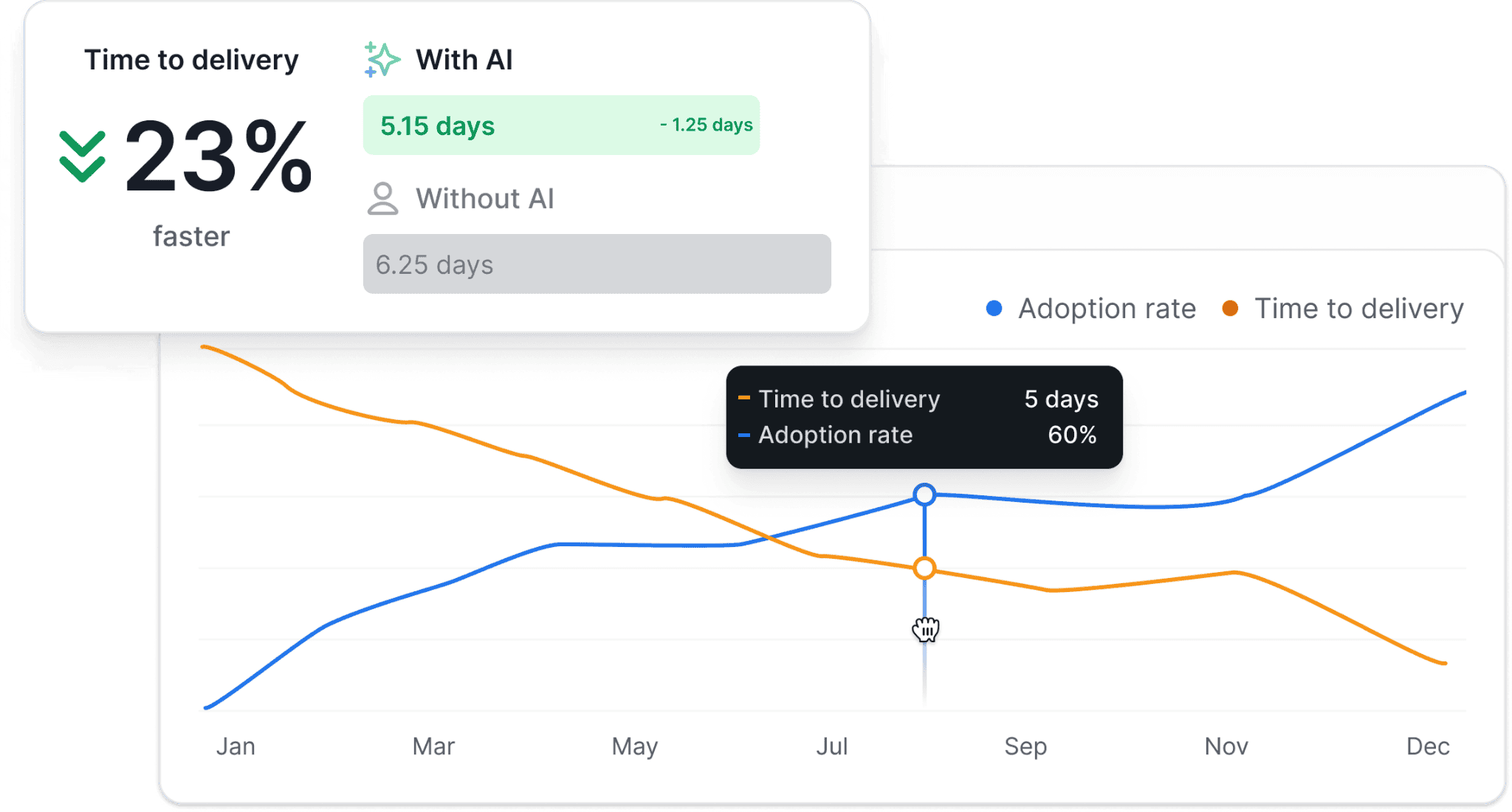
From our perspective, comparing speed metrics before and after AI adoption shows you whether AI is actually improving speed or simply moving the slowdown somewhere else.
But let's not forget about software quality.
Here, we’ll analyze the metrics commonly used to evaluate reliability and long-term maintainability in modern engineering environments.
Reliable systems depend on consistent validation throughout development, testing, and release stages. To avoid quality issues appearing after deployment, use indicators that expose risk earlier in delivery.
AI tools now assist many parts of the development workflow. Yet faster code generation does not automatically improve reliability. For that reason, engineering leaders need visibility into how AI influences delivery and reliability metrics.
Axify evaluates several indicators so you can understand this relationship:
To understand the real effect on quality, Axify also compares several metrics before and after AI adoption:
From our experience analyzing clients’ delivery data, the pattern becomes clear:
All of this takes us to the next point.
Balancing speed and quality means adjusting how work moves through the PR, CI, and release pipeline.
Once you understand where PR wait times, CI failures, rework, or production incidents appear, you can make workflow changes that accelerate delivery speed without increasing defects.
We advise you to try the methods below.
The fastest way to balance speed and quality is to use automation and the right tooling to understand how your delivery system behaves.
Manually analyzing multiple signals takes lots of time, while engineering intelligence tools like Axify help you see where to act and what to improve.
Axify Intelligence connects with your existing development tools, analyzes delivery performance continuously, and turns workflow data into decision support for engineering leaders.
Axify’s engineering intelligence helps by:
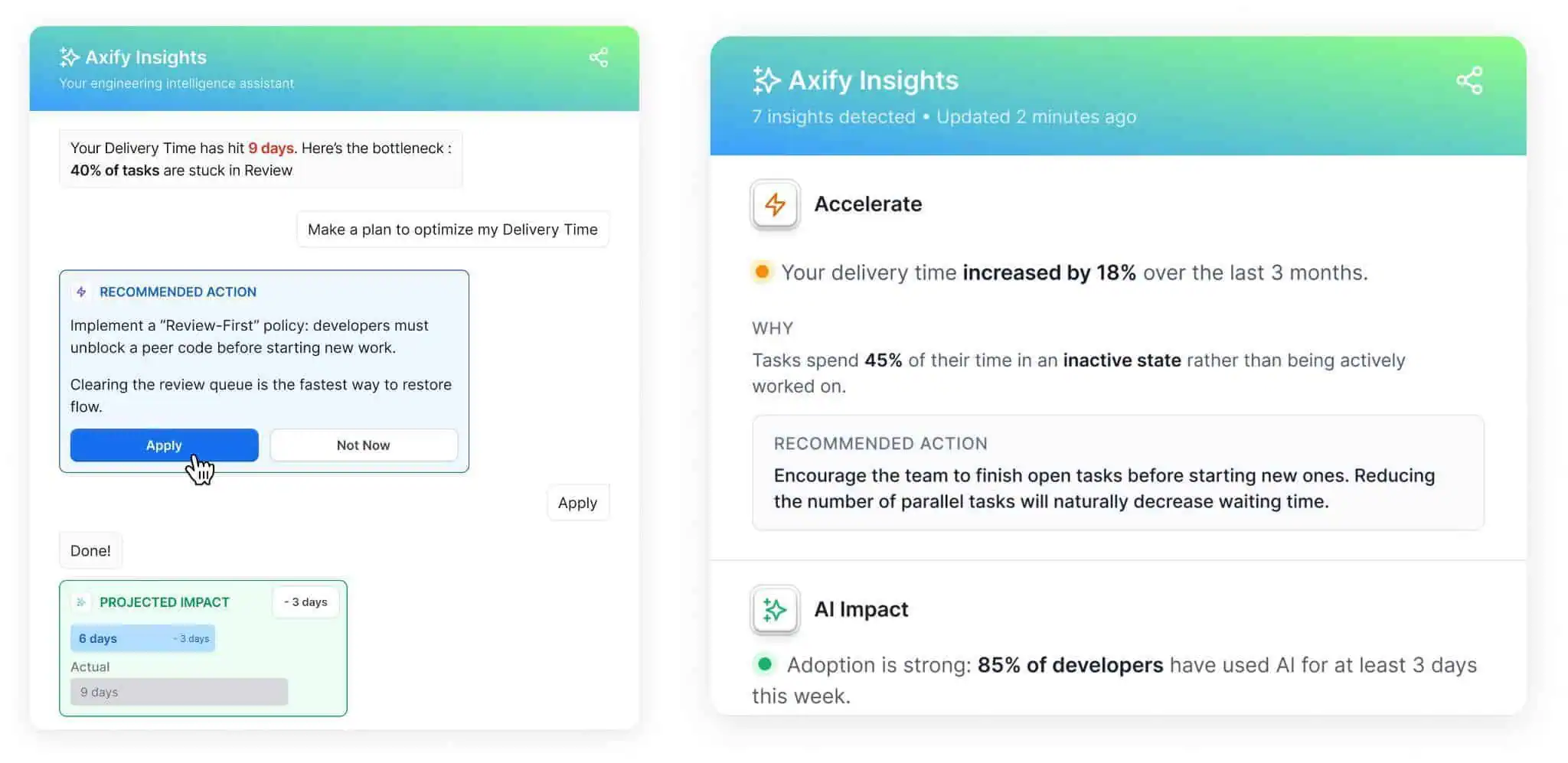
From our experience, visibility is important, but correct decision-making is essential. That’s the problem we’re solving for our clients at Axify.
If you prefer a more hands-on approach, the following tactics can help improve delivery speed and quality at the workflow level.
Once bottlenecks become visible, the next step is to reduce batch size. Batches are defined as the number of tasks, items, or units grouped for processing, development, or transmission.
Large batches reduce transparency, which leads to an increase in issues and, as a result, a higher cost of solving them. You’ll also see more integration effort and variability, plus delayed value.
Smaller increments solve these problems.
Each batch of work becomes easier to review, faster to validate in CI pipelines, and safer to deploy. In practice, this means delivering minimal viable increments that focus on a single improvement or feature adjustment.
These smaller changes surface issues earlier and reduce the likelihood of large failures during deployment. In turn, this leads to cost optimization, faster time to market, and more value delivered to end users.
Faster delivery increases the amount of work moving through the delivery system. However, manual validation cannot keep pace with this higher throughput, which increases the risk of production defects.
Automation closes this validation gap. CI/CD pipelines automatically validate new code after commits, while automated test suites verify expected system behavior and detect regressions before deployment. Parallel test execution can further shorten feedback cycles by validating multiple work items simultaneously.
These practices allow teams to move work through development, testing, and release stages more quickly while maintaining consistent quality standards.
Even with strong testing practices, systems accumulate complexity over time. Refactoring postponed for too long eventually slows development because engineers must work around harder-to-change code paths or unclear dependencies.
Managing technical debt prevents that slowdown. Tracking rework patterns usually reveals where design limitations cause repeated fixes or extra validation effort. Allocating regular time for refactoring keeps systems easier to modify and prevents delivery friction in future releases.
Code reviews protect implementation quality, but poorly structured review practices can slow delivery. When reviewers receive large batches of work or frequently switch context, review queues grow and feedback arrives late.
A more effective approach focuses reviews on logic, risk, and the scope of each work item. Limiting the size of work batches and time-boxing review sessions reduces cognitive load for reviewers.
As a result, feedback arrives earlier, and developers can address issues before additional work items accumulate in the delivery system.
Delivery performance depends heavily on the people responsible for maintaining it. When workloads become unrealistic, or incident response dominates daily work, delivery quality drops as teams spend less time on careful review and validation.
Maintaining sustainable workloads prevents repeated delivery issues. Regular retrospectives help identify recurring sources of friction, while realistic planning reduces the pressure that usually leads to rushed changes or incomplete testing.
Delivery success is not measured by technical execution alone. Ultimately, released features must address real user needs.
Continuous feedback from users and stakeholders helps teams adjust priorities quickly. Early input reveals whether a feature actually solves the intended problem or requires further refinement.
This feedback loop allows teams to validate direction earlier and avoid investing more effort in work that misses the requirement.
Speed and reliability improve together when teams manage how work flows through the delivery system. Smaller work batches shorten review cycles, automated validation protects reliability before code reaches production, and delivery metrics reveal constraints that slow reviews, testing, or deployment.
These signals tend to point to the same root causes: oversized work batches, delayed feedback loops, or overloaded review stages. When those patterns become visible, engineering leaders can make targeted workflow adjustments that improve both delivery speed and stability.
Axify supports those decisions by analyzing delivery data, identifying workflow constraints, and recommending improvements based on real delivery patterns.
If you want to analyze your delivery data and apply improvements directly from your engineering intelligence platform, schedule a demo with Axify today.

Not necessarily. Many teams ship faster today due to automation, CI/CD pipelines, and AI-assisted development. However, higher delivery speed can expose weaknesses in testing practices, code readability, or review standards. When teams adopt new tools without updating validation practices, defect rates can increase.
Both matter. Startups may tend to prioritize speed to validate product ideas quickly, but poor quality can slow future development and increase operational risk. Sustainable delivery requires balancing speed and quality, typically through small work batches, automated tests, and disciplined review practices.
Software quality is usually measured through indicators such as defect density, production incident frequency, and change failure rate. Teams maintain quality through practices like unit testing, pair programming, automated CI pipelines, test-driven development, and consistent code reviews that enforce code readability and maintainability standards.
No. Speed alone does not capture the full impact of a software developer. Effective developers also contribute to maintainable code, system reliability, and knowledge sharing within the team. Metrics such as review participation, code clarity, and architectural improvements tend to have a larger long-term impact than raw output.
Neither extreme works well in modern software engineering. High-performing teams aim for fast feedback cycles while maintaining strong quality controls. Practices like trunk-based development, automated testing, and small pull requests allow teams to move quickly while preserving code quality.