SEI
15 minutes reading time

Allstacks expanded beyond engineering analytics in 2026 to cover product requirements, engineering delivery, and software capitalization.
Most teams don’t start looking for an Allstacks alternative because Allstacks is missing a feature, but because the tool isn’t answering the question they actually have, whether that’s “why is our sprint completion rate dropping,” “where is AI adoption actually saving us time,” or “can I trust this number in a board deck.”
That’s a useful filter.
Before comparing feature lists, get clear on which question you’re trying to answer, since that’s what separates the platforms below more than pricing or UI ever will. Some tools are built to surface team-level friction day to day. Others are built to translate engineering data into a language your CFO will trust. Very few do both well, and the ones that claim to usually make you pay for it in setup time or accuracy.
In this guide, we’ll help you compare several Allstacks alternatives by use case, named features, and pricing. You will see which platforms fit your needs, what you would give up with each option, and which vendors deserve a closer look.
Here are the options you can compare:
| Vendor | Best for your need | Key features | Pricing |
|---|---|---|---|
| LinearB | Team delivery automation | gitStream, DORA, allocations | $29/user/month, annual |
| Jellyfish | Engineering investment allocation | Allocations, DevFinOps, AI Impact | Custom quote |
| Faros AI | Configurable engineering data | Token Intelligence, roadmap delivery | Custom quote |
| Axify | AI adoption, impact, and cost tied to delivery | AI Adoption & Impact, AI cost, Axify Intelligence, DORA | From $29/active contributor/month, annual |
| Swarmia | Team improvement | Working Agreements, surveys, capitalization | Free up to 9; $45/developer/month, annual |
| Haystack | Delivery risk tracking | Delivery Data Layer, custom boards | $20/member/month, annual |
| Larridin | Cross-department AI adoption measurement | Adoption, spend, human-and-agent measurement | No public pricing |
| DX | Developer surveys combined with SDLC data | DX Core 4, Developer Experience Index, AI measurement | Custom quote |
Let’s get started!
Allstacks is an agentic platform that lets you define product requirements, monitor software delivery, and classify development costs in one system. Its scope expanded in 2026 when Product Studio was launched alongside its established engineering intelligence and capitalization capabilities.
The platform now includes three connected products:
Across these products, the Context Graph gives you a shared data layer. It connects information from product, project management, code, delivery, documentation, and finance tools. Then, it maps relationships between strategies, tickets, commits, and sprints.
As a result, you can follow a requirement from planning through delivery and financial classification within the same platform.
For market context, you can also consider Allstacks’ Visionary placement in the 2026 Gartner Magic Quadrant for Developer Productivity Insight Platforms, published on May 5, 2026. Allstacks announced the placement the following day, while Gartner cautions that placement does not represent a vendor endorsement.
You may look for an Allstacks alternative when its price, product scope, or leadership focus exceeds what your team needs. The right choice depends on which workflows you expect the platform to support.
Per-contributor pricing makes team size one of your main budget considerations. Allstacks Growth costs $400 per contributor per year, while Enterprise starts at $600 and requires at least 100 contributors. Standalone Cost Capitalization adds $200 per contributor annually. Support is a paid add-on on Growth and standalone Cost Capitalization, and included in Enterprise.
At these rates, Growth costs $40,000 per year for 100 contributors, and standalone Cost Capitalization adds $20,000. Bundle and volume discounts can lower your final quote, but you still need to calculate the full annual cost as your contributor count and product requirements change.
Allstacks now supports requirements development, delivery forecasting, AI measurement, developer surveys, and financial reporting across the software delivery lifecycle. That feature breadth is great when you need one platform for product, engineering, and finance.
However, your requirements may be narrower. If managers mainly need to follow essential metrics like cycle time, deployment frequency, or pull requests data, a focused alternative may require less configuration and provide fewer unused capabilities.
Allstacks is built primarily for engineering leaders. Its core capabilities include portfolio forecasts, delivery risk assessment, investment allocation, and executive reporting. Team- and pull-request-level metrics, such as PR response time, are available but represent a secondary focus.
Managers who coach teams on a daily basis typically require different capabilities: stuck-PR alerts, reviewer routing, Slack notifications, and team agreements built into the delivery workflow. If these capabilities matter to your managers, evaluate platforms designed around them specifically.
Before selecting a vendor, determine which need takes priority: leadership reporting or day-to-day team coaching. This distinction will clarify which platforms are well-suited to your requirements.
The best Allstacks alternatives are LinearB, Jellyfish, Axify, and Faros AI. Your shortlist may also include Swarmia for a comparably broad engineering intelligence platform, Haystack for a leaner, DORA-focused tool, Larridin if you need AI-adoption tracking beyond engineering, or DX if developer surveys matter as much as delivery data.
If you are comparing more broadly, see our guides to Pluralsight Flow alternatives and BlueOptima alternatives.
Here are the eight options and the exact differences you should review.
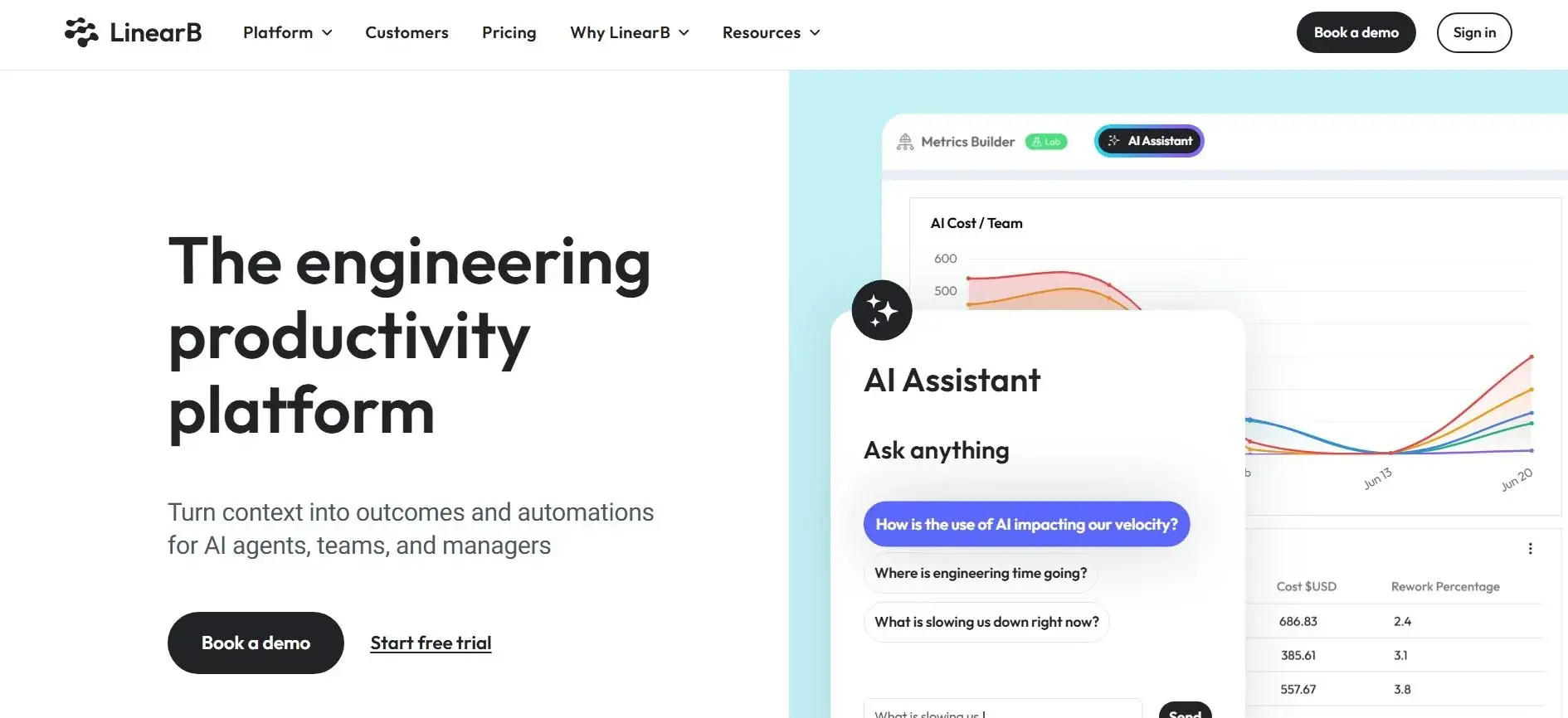
Best for: Teams that want to automate pull-request workflows alongside delivery metrics.
LinearB gives you delivery metrics from source-control, project-management, and CI/CD data. You can review DORA metrics, project progress, engineering investment, developer experience, and the effect of AI-generated code across teams.
Differentiator: gitStream. gitStream lets you define automation rules for pull-request labels, reviewer assignments, approvals, and CI checks. For example, you can route a security-related change to a specific reviewer or approve a low-risk documentation update automatically, which places LinearB closer to daily pull-request work than Allstacks’ broader portfolio reporting.
Main downside: Repository access. To calculate Git metrics, LinearB clones (or shallow-clones) your repositories, extracts metadata, and then deletes the copy. It does not store your code, but teams with strict access policies should review this model with their security team.
Pricing: The Essentials plan starts at $29 per user per month with annual billing and includes 1,000 monthly AI credits per user.
Pro tip: See how LinearB compares with other platforms in our LinearB alternatives guide.
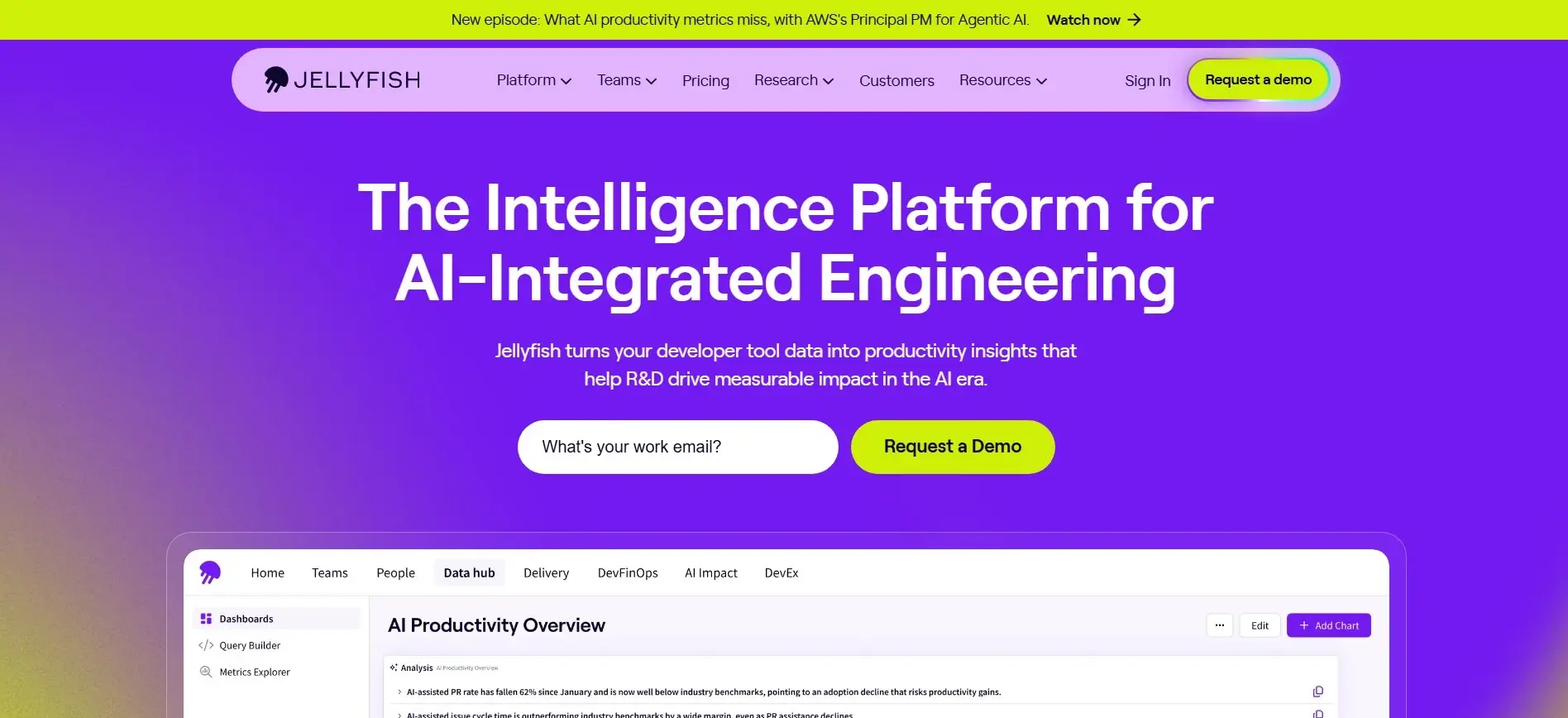
Best for: Organizations that need to report engineering investment and allocation to finance.
Jellyfish combines engineering delivery, investment allocation, developer experience, AI impact, and financial reporting. Its modules let you examine where engineering capacity went, how work progressed, and which development costs may qualify for capitalization.
Differentiator: Jellyfish Allocations. Allocations uses Jellyfish’s Work Model to estimate how engineering effort is distributed across initiatives, products, work categories, and business units.
This gives you an FTE-based view of engineering investment without asking developers to complete timesheets.
Main downside: Allocation accuracy depends on setup. The Work Model needs your teams, projects, and work categories to be mapped correctly before its investment view becomes reliable.
Pricing: Custom quote.
Best for: Large organizations that want a configurable engineering data platform, including AI token spend.
Faros AI brings data about teams, software tools, processes, and AI agents into an engineering data platform. You can use that connected data to examine roadmap delivery, productivity, code quality, and returns from AI-assisted development.
Differentiator: Token Intelligence. Token Intelligence maps token spending to specific teams, tools, models, tasks, and time periods.
Faros then classifies the associated sessions as productive, inefficient, or wasteful based on patterns such as repeated attempts, weak prompts, and missed context reuse. These classifications require detailed AI and engineering telemetry, so you should confirm which coding assistants can provide the required data.
Main downside: Setup effort. Faros is a configurable data platform, so reliable reporting depends on connecting and mapping your data sources and agreeing on metric definitions. That takes longer when teams use homegrown tools or non-standard systems.
Pricing: Custom quote.
Best for: Engineering leaders who need AI adoption, impact, and cost tied to delivery metrics at the team level.
Axify is an engineering intelligence platform for AI-augmented teams. It tracks AI coding-tool adoption, impact, and cost alongside DORA metrics, pull-request data, delivery-flow measures, and value stream management, in the same platform.
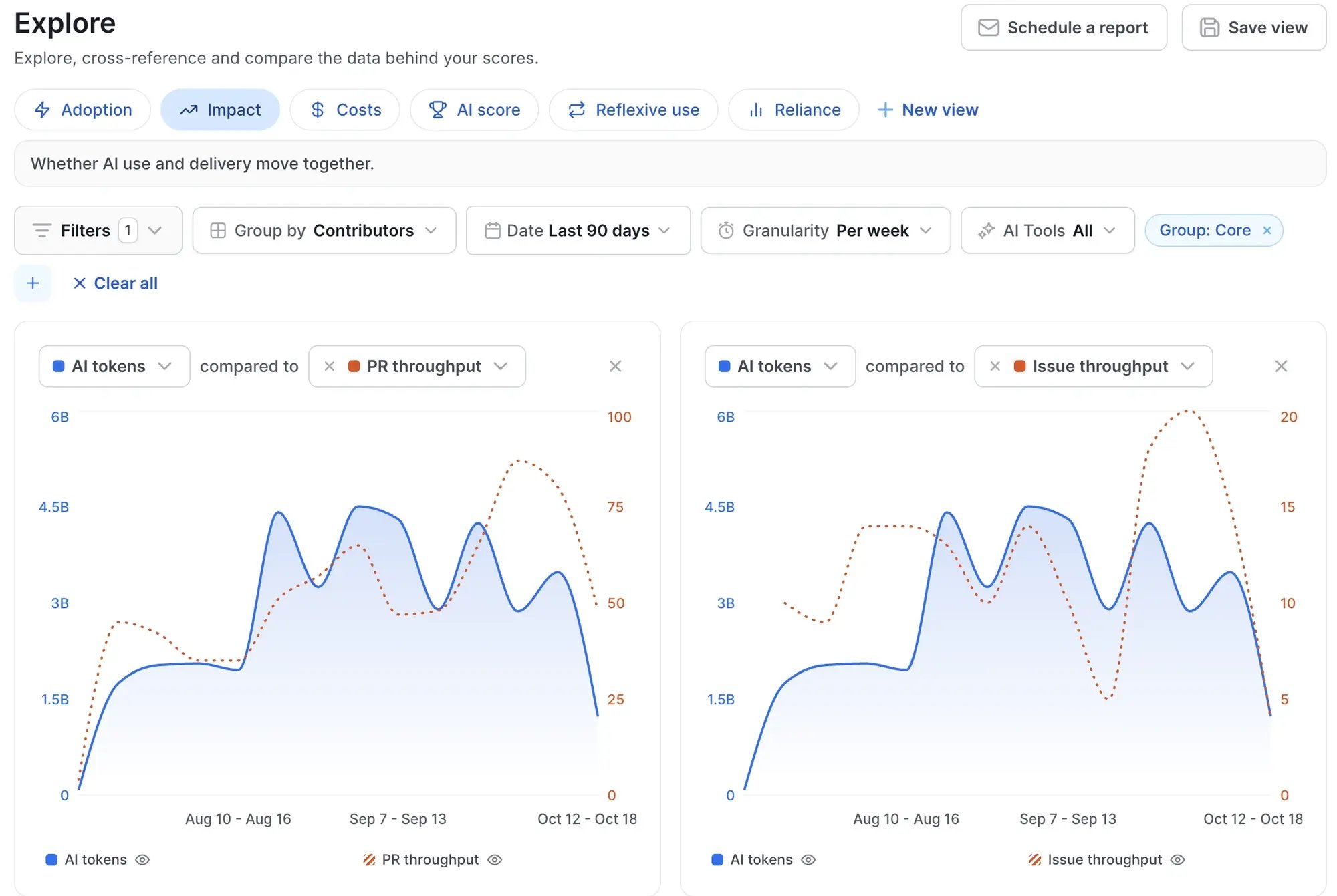
The platform connects project-management, source-control, CI/CD, incident, and AI-tool data. This lets you review whether using AI more leads to improvements in review time, deployment frequency, or cycle time at the team or organization level. The AI Adoption and Impact feature also breaks down AI cost and token usage by tool and model.
Besides, the Axify MCP server puts live DORA, flow, and AI adoption metrics straight into the AI tools your leaders already use. They can ask complex engineering questions from Claude, Cursor, or the AI assistant they already use and get accurate answers instead of analyzing different dashboards themselves.
Differentiator: Axify Intelligence. Axify Intelligence continuously analyzes connected delivery data to flag anomalies and bottlenecks. It adds root-cause context and suggested actions, so you can adjust review capacity, work-in-progress limits, or another team process right from the platform.
In Axify’s Business Development Bank of Canada (BDC) case study, two teams achieved delivery improvements of up to 51% after three months. Since this is vendor-published evidence, you should review the case-study method and compare its starting conditions with your own teams.
Main downside: Axify doesn’t offer an R&D cost capitalization or software capitalization module (unlike Jellyfish, Swarmia, or Allstacks, which all have this feature.)
Pricing: Pro starts at $29 USD per active contributor per month, billed annually. Enterprise pricing is available on quote.
Best for: Teams that want working agreements and developer surveys alongside delivery metrics.
Swarmia reports engineering performance, AI impact, investment allocation, software capitalization, and developer-survey results. You can view these engineering data at team and organization levels after connecting development and collaboration tools.
Differentiator: Working Agreements. Working Agreements lets a team define numeric targets and development practices inside Swarmia. For example, managers can set a maximum pull-request review time and receive Slack or Microsoft Teams notifications when work exceeds it.
This makes the feature a daily exception-management workflow rather than a portfolio forecast. Each team must agree on suitable thresholds for the notifications to remain useful.
Main downside: Integration gaps on some stacks. Swarmia supports GitHub and GitLab, but not Bitbucket, and Azure DevOps source control is only available on demand for some Enterprise customers.
Pricing: Standard costs $45 per developer per month with annual billing, and a free plan covers teams of up to nine developers.
Pro tip: See how Swarmia compares with other platforms in our Swarmia alternatives guide.
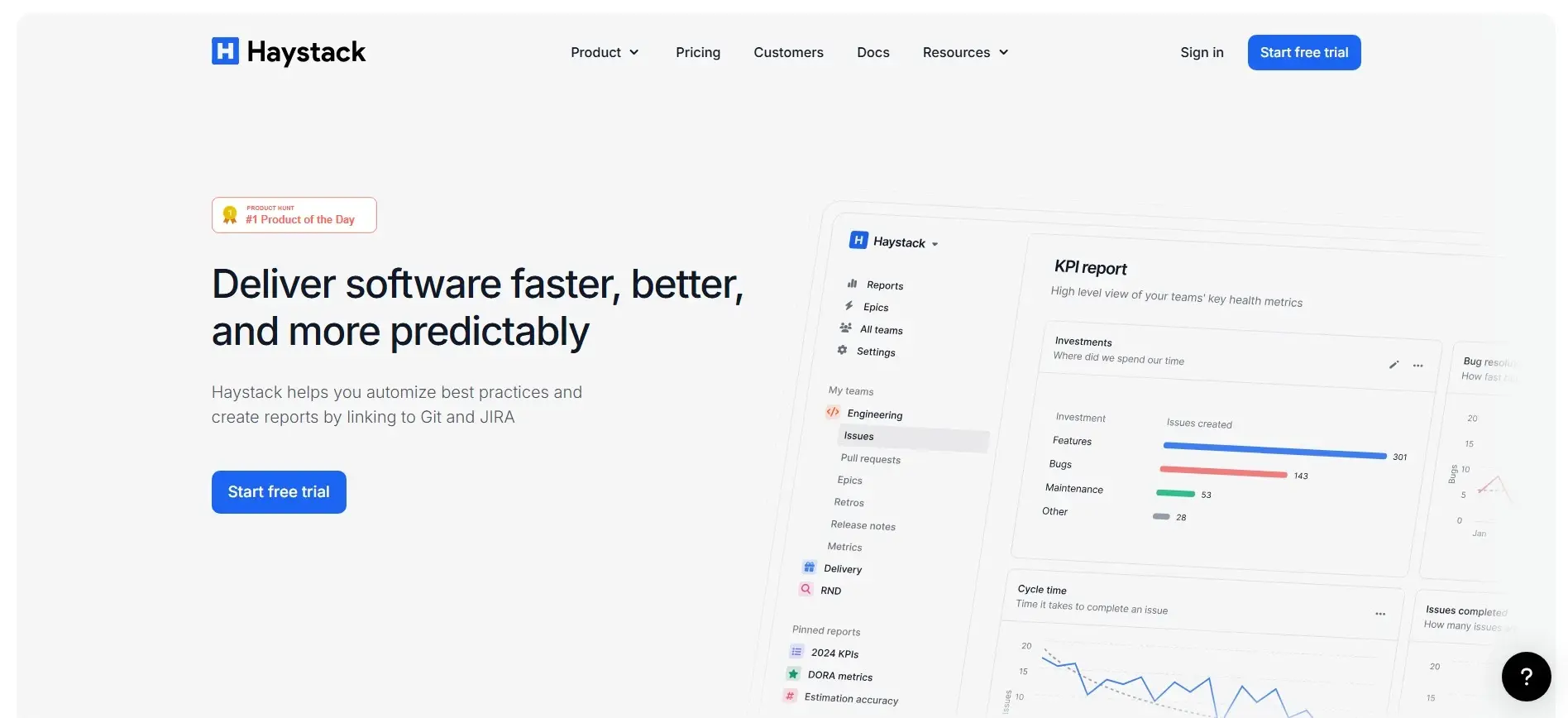
Best for: Teams that want lightweight delivery and risk reporting at a lower per-seat price.
Haystack monitors delivery trends, project risks, release progress, and engineering KPIs. You can use its dashboards and weekly reports to review tasks, commits, code reviews, and releases across the product creation lifecycle.
Differentiator: Delivery Data Layer. The Delivery Data Layer connects items from project-management and development systems into a shared lifecycle model.
From there, you can query the data or build custom boards for a product, team, or release. This approach gives you control over reporting. However, custom boards require clear metric definitions so different teams do not calculate the same measure in different ways.
Main downside: Plan limits. Support for self-hosted GitHub Enterprise and GitLab Enterprise is only available on the Enterprise plan, and the Growth plan keeps 12 months of historical data.
Pricing: Haystack Growth costs $20 per member per month with an annual commitment.
Best for: Companies measuring AI adoption across engineering and other departments.
Larridin measures AI adoption, fluency, spending, and impact across engineering and other business functions. Its engineering product also covers velocity, quality, cycle time, developer sentiment, AI Code Share, and Code Durability.
Differentiator: Human-and-agent workforce measurement. Larridin evaluates employee activity and AI-agent activity through the same enterprise measurement layer.
This extends its scope beyond engineering and lets you examine AI workflows across departments. However, Larridin states that it is not primarily an engineering intelligence platform, so you should not treat it as a direct replacement for every Allstacks product.
Main downside: Breadth over engineering depth. Because Larridin measures AI across departments, check whether its engineering metrics go deep enough for your delivery reviews before you choose it.
Pricing: Custom quote.
Best for: Large engineering organizations that want to combine developer surveys with SDLC and AI measurement.
DX combines engineering-system data with feedback from developers. You can track DX Core 4, DORA, SPACE, and developer experience metrics, along with AI adoption and AI-generated code for supported tools. Atlassian acquired DX in 2025, which may matter if your teams already work in Jira.
Differentiator: Developer Experience Index and experience sampling. DX pairs system metrics with recurring developer surveys, so you can see where friction comes from, not only where work slows down.
Main downside: Rollout effort. The full survey and reporting feature set takes time and configuration to roll out across teams, and survey results depend on developer participation.
Pricing: Custom pricing, available through a demo.
Pro tip: See how DX compares with other platforms in our DX alternatives guide.
Your choice depends on whether you need team-level delivery analysis, pull-request automation, or broader product and financial reporting. The table above covers the feature and pricing details, so these comparisons focus on the main differences between each platform.
Axify gives you a more focused way to find delivery bottlenecks and measure AI’s impact on team performance. It combines DORA metrics, value stream mapping, pull-request data, and AI-tool usage and cost, all through a small set of essential metrics instead of a large configurable library, which keeps the signal clear for engineering leaders who don’t want to build their own dashboards.
Beyond adoption and before/after impact tracking, Axify forecasts AI cost and breaks down cost and token usage by tool and model, so you can see where premium models are used. Axify Intelligence then flags anomalies, explains which delivery stage needs attention, and gives specific improvement recommendations.
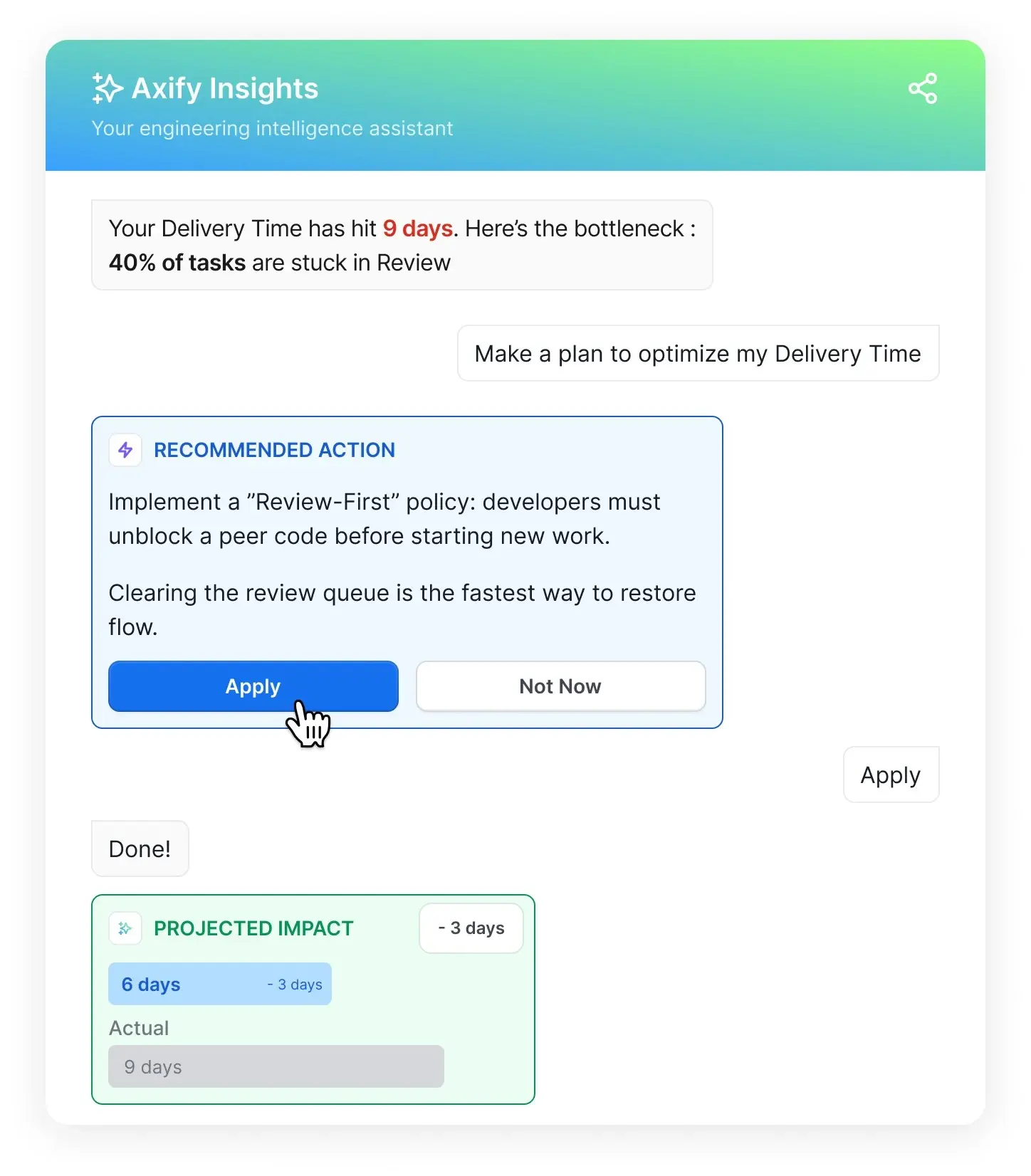
The Axify MCP server extends this further, letting you query engineering and AI-adoption data directly from tools like Claude or Cursor.
Allstacks covers a wider process through product requirements, portfolio forecasting, and cost capitalization, backed by over 100 configurable metric views for teams that want to build custom reporting. So, choose Axify when your priority is a focused, low-noise view of software delivery and AI impact at the team level and Allstacks when you need breadth across the full product-to-financial-reporting lifecycle.
LinearB focuses more closely on daily pull-request workflows. Its gitStream feature handles reviewer assignments, labels, approvals, and automated checks.
Allstacks gives you broader delivery insights across product planning, engineering investment, portfolio forecasts, and finance. Your decision therefore depends on whether pull-request automation or leadership-level reporting carries more weight.
Both platforms connect engineering work with investment and financial reporting. Jellyfish centers its approach on resource allocation, developer productivity, AI impact, and DevFinOps.
Allstacks extends this coverage into requirements through Product Studio and its Context Graph. Jellyfish fits an evaluation focused on where engineering capacity goes, while Allstacks covers the path from product requirements through delivery and capitalization.
Choose the Allstacks alternative that fits the team size you need to cover, the budget you can confirm, and the exact workflows you want to measure. Here’s what you need to think about.
Count everyone whose Git, project-management, and deployment activity must appear in your reports. Then check whether you will pay a flat fee, a per-contributor rate, or a minimum annual contract as your team grows.
Axify and LinearB publish their pricing, so you can prepare an initial annual estimate before speaking with sales. Jellyfish and Faros require custom quotes, which means you need to confirm seat counts, modules, data sources, and support requirements before you can compare total costs.
If you need requirements management alongside engineering and financial reporting, Allstacks’ wider product scope may still match your evaluation. When you mainly need delivery metrics, value stream analysis, pipeline health, or the effect of AI development on team performance, choose a delivery-focused alternative such as Axify.
We advise you to choose an Allstacks alternative based on the exact problem you need the platform to solve. If you need requirements management, portfolio forecasting, and cost capitalization in one system, Allstacks may still fit your evaluation.
But if your priority is delivery, Axify gives you a sharper tool: map delivery flow, find bottlenecks, and track DORA metrics.
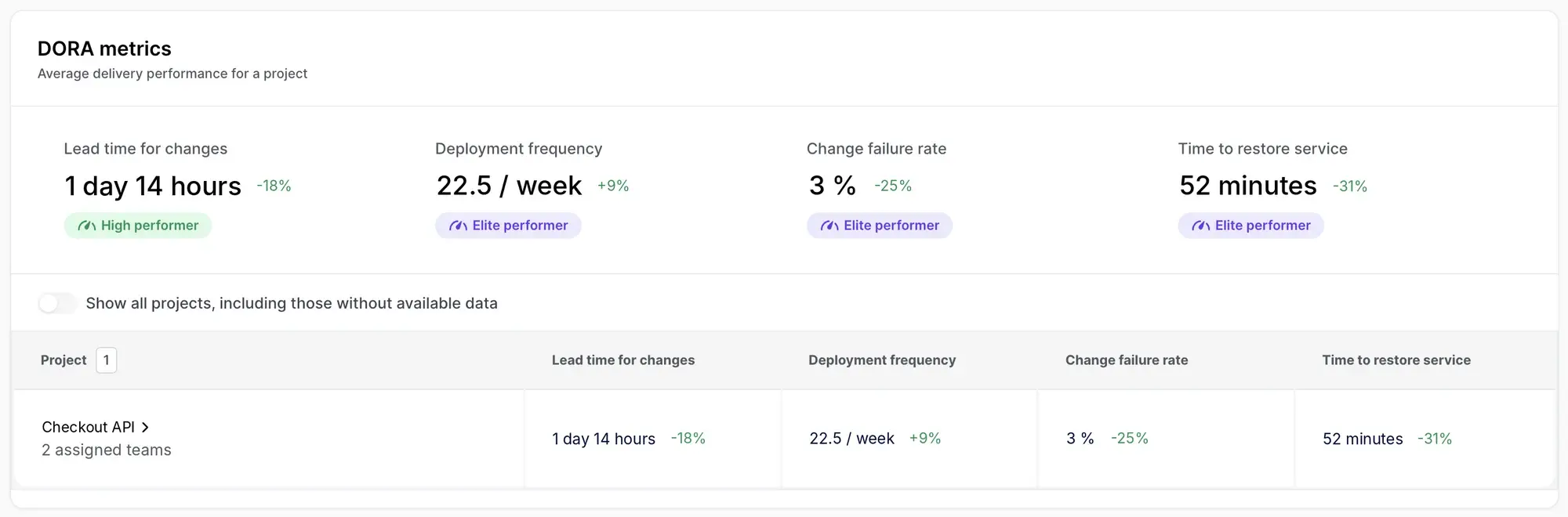
It also goes further on the AI side than most Allstacks alternatives: it tracks AI adoption and before/after impact by team and tool, forecasts AI cost, and breaks down cost and token usage by tool and model. Axify Intelligence turns all of this into concrete recommendations, and the Axify MCP server lets you query your delivery and AI-adoption data directly from tools like Claude or Cursor.
Before you commit, confirm two things: how pricing scales as your team grows, and whether the platform connects to your issue tracker, Git provider, CI/CD pipeline, incident system, and AI coding tools.
Choosing between AI coding tools themselves? Read Axify's full comparison of 20 AI coding assistants to see how tools like Copilot, Cursor, and Claude Code stack up before you decide which ones to measure.
Want to see how Axify measures AI adoption, impact, and cost against your delivery data? Book a demo with Axify.

No, Allstacks is broader than its earlier engineering intelligence focus. In 2026, it expanded with Product Studio for automating requirements and product planning. You can now use the platform across product management, engineering delivery, and software cost capitalization.
Allstacks Growth costs $400 per contributor annually, while Enterprise starts at $600 and requires at least 100 contributors. Standalone Cost Capitalization costs $200 per contributor annually. Product Studio Starter is currently free, with unlimited usage “for now,” and volume or bundle discounts may apply.
Yes, Swarmia offers a free plan for companies with up to nine developers. Axify also has a 14-day free trial without a credit card to follow delivery metrics and AI impact tracking.
Axify is quick to set up for a small team. You connect your project-management and source-control tools, then Axify imports delivery data automatically.
Yes, Allstacks provides product management through Product Studio, but not the full product management lifecycle; it can help you research ideas, write and refine requirements, test spec readiness, and prepare tickets for engineering. Its Context Graph then connects those requirements with delivery and financial data, so you can trace a spec through to what it cost to build. However, Allstacks doesn’t handle roadmapping, prioritization frameworks, or product discovery on its own.
Axify is the best Allstacks alternative when you need to compare AI adoption with team productivity and software delivery results at the team level. Axify AI Adoption and Impact shows AI usage metrics, as well as delivery metrics before and after AI adoption. It also breaks down AI cost and token usage by tool and model.