Delivery Performance
14 minutes reading time

Measuring engineering productivity shows you the status quo. Decisions determine what changes next.
The issue is not always missing data. If you have good data, how you interpret it matters just as much.
You might already track essential engineering metrics. Yet leadership still asks: what changed, and what should we adjust?
This means you should move from mere reporting to explaining cause and effect, as our client Newforma did.
After working with us at Axify for five months, the team reduced lead time for changes by 63%, cut PR cycle time by 60%, and increased deployment frequency by 2,150%, which resulted in 22x more deliveries. Those gains came from identifying bottlenecks, reorganizing teams, and tightening validation and deployment processes.
In this article, you will see how measuring productivity becomes the foundation for engineering decisions that lead to real business results. Plus, you will learn how to design a system that tells you what to change next and why.
Measuring engineering productivity means building a decision model that uses delivery signals to explain system behavior and guide action. As such, you need to decide which metrics can support planning and risk management.
Measurement starts with separating signals from outcomes.
Metrics like lead time, deployment frequency, or work-in-progress reflect how your delivery system operates. Revenue, retention, or customer growth are business outcomes shaped by many variables. Conflating them creates false accountability and weakens planning decisions.
Remember: Every metric is a representation of system behavior. What matters is how reliably it reflects what is happening inside the delivery workflow.
Once these signals are defined, the next step is understanding when they appear in the delivery process. This is where the distinction between leading and lagging indicators becomes useful.
If you want to measure engineering productivity, combine both. Leading indicators allow early intervention, while lagging indicators confirm whether interventions worked.
If you build a model that remains reliable under real delivery conditions, it will support better decisions over time.
As two experts explain:
Most engineering productivity measurement fail because it produces static reports that don’t help you make better decisions. Data accumulates, but trade-offs remain unclear, and accountability does not change. This usually happens for structural reasons.
These are the most common measurement system failures you might encounter:
You can certainly manage measurement without a dedicated platform, but having one makes the process much smoother and gives you back valuable time when it matters most.
When evaluating platforms, focus on whether they feature essential engineering metrics that you can easily translate into action.
These are the three layers you should examine.
Most tools aggregate metrics and display them through dashboards. They surface DORA indicators, flow metrics, pull request throughput, and stability trends. That visibility matters because you need shared baselines.
Axify covers this layer thoroughly. You can track:
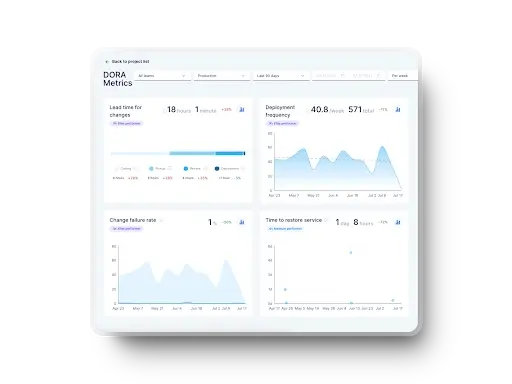
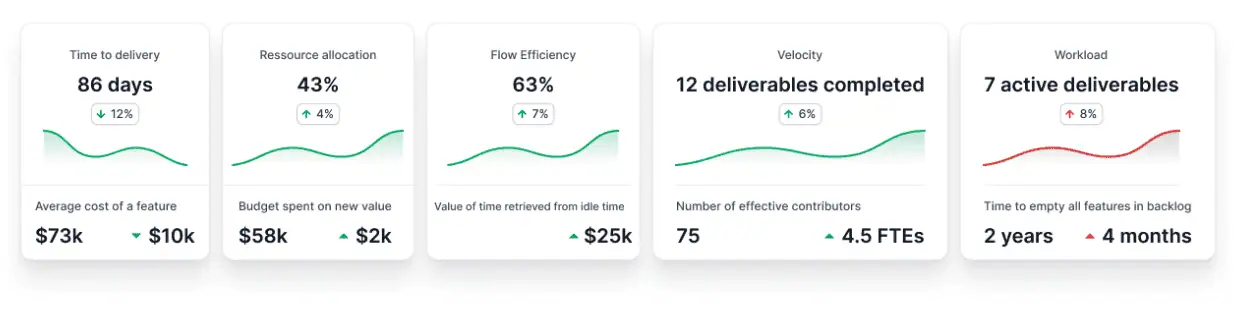

These capabilities give you detailed key performance indicators across the delivery lifecycle.
However, some platforms stop at exposure. Dashboards show what happened, but do not explain why it happened or which policy to adjust.
For example, if review time increases, the tool may show longer queues but rarely connect that to pickup delays, large pull requests, or ownership rules. As a result, leaders don’t have the full picture.
Visibility is necessary. Yet visibility alone does not resolve prioritization debates or forecast uncertainty.
That gap leads to the next requirement.
Before optimizing, you need to understand baseline maturity.
Axify’s Developer Productivity Assessment gives you a standardized evaluation of your engineering productivity across four pillars:
First, you connect your existing toolkit to automatically capture delivery data. Then, you complete a concise questionnaire to capture qualitative context. Finally, you receive a consolidated report that compares teams against consistent benchmarks.
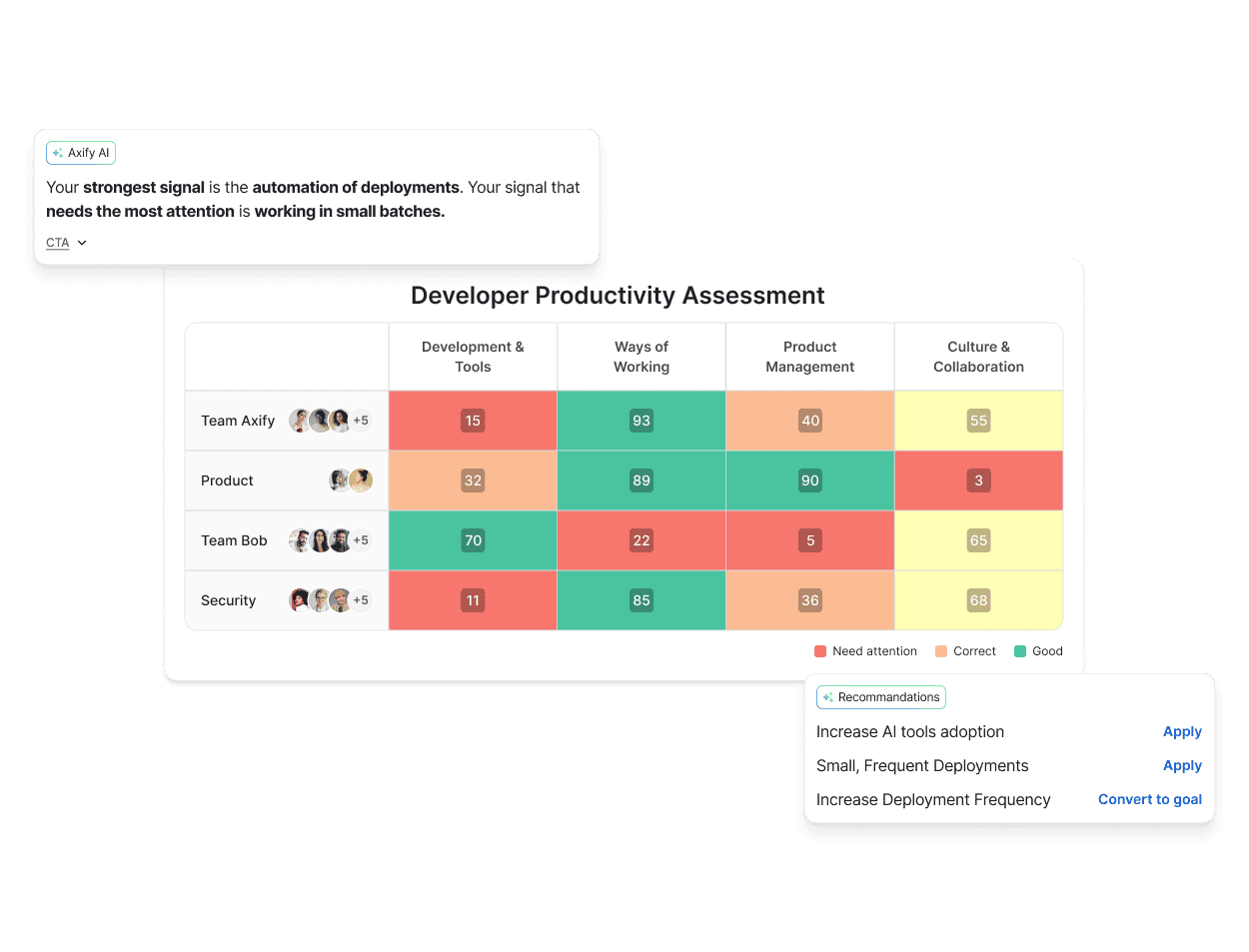
This function serves a different purpose than metrics dashboards: it identifies structural gaps and doesn’t focus specifically on daily performance.
For example:
So the function of this assessment is:
And most importantly:
It separates maturity from output.
A team can ship a lot of code and still be structurally fragile. The assessment measures structural readiness and process strength, so improvement can be measured over time against a consistent baseline.
Even with strong visibility and baseline assessments, interpretation remains complex because delivery systems involve multiple interacting constraints.
When a queue expands, the cause may be higher review load, increased context switching, or rising code volume from AI-assisted changes. A dashboard can show the queue growth, but it rarely explains which operational condition triggered it.
This is where decision-layer capability matters.
Axify Intelligence analyzes delivery patterns continuously and surfaces insights tied to workflow decisions.
Instead of presenting isolated metrics, it:
Pro tip: Because it operates on your internal delivery history, this AI assistant’s recommendations reflect your system context. In other words, it doesn’t offer generic advice like basic LLMs.
For instance, if delivery time increases 18% over three months and tasks remain inactive for extended periods, the system can connect inactivity patterns to queue expansion and suggest finishing open tasks before starting new ones. That explanation links the signal to the cause and proposed correction.
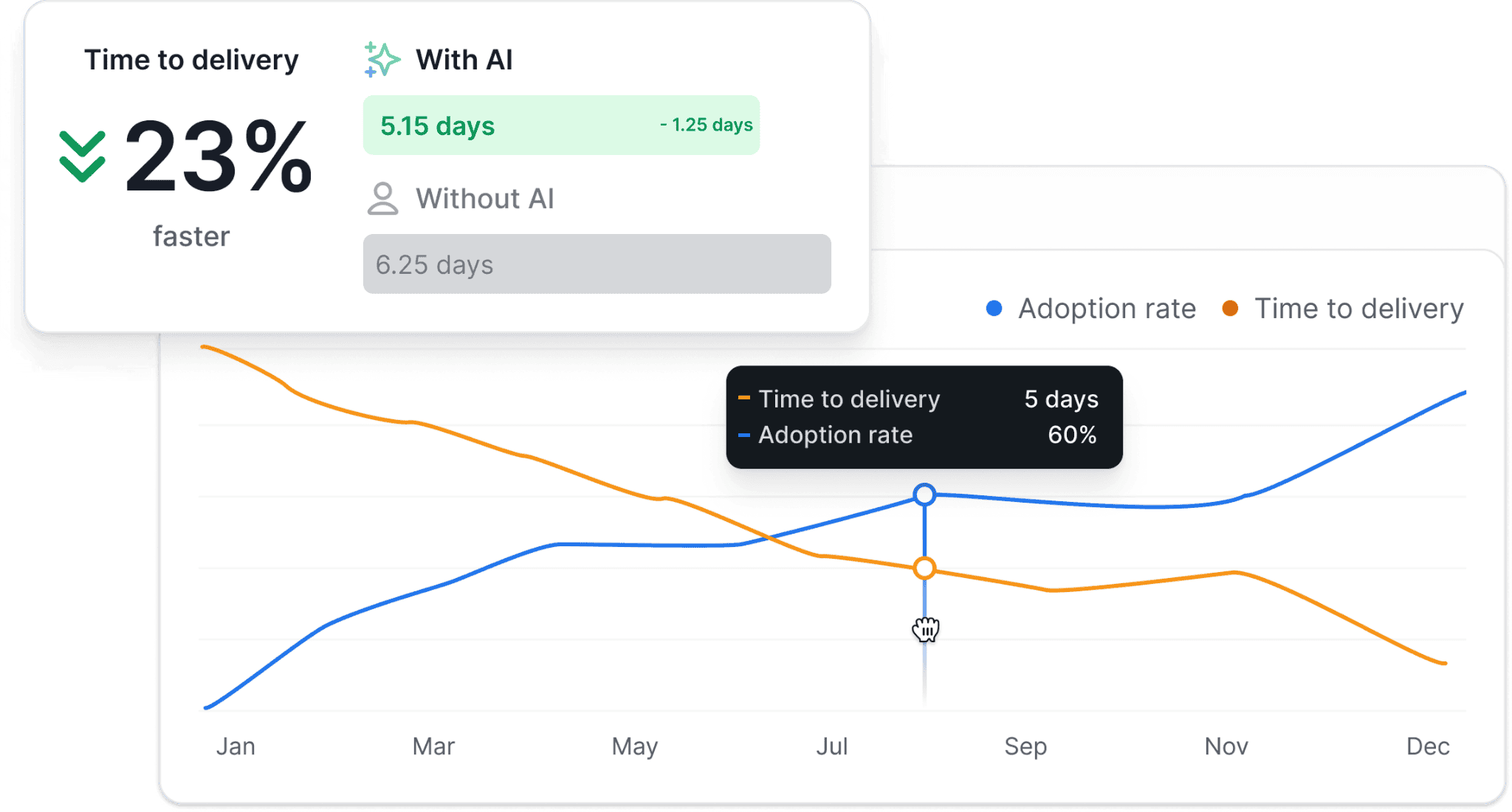
Additionally, you can see AI-related insights regarding how AI adoption influences your engineering productivity.
If AI-assisted tasks move faster but code review duration expands, the system surfaces that trade-off. This helps you balance speed against stability and maintain discipline around continuous improvement.
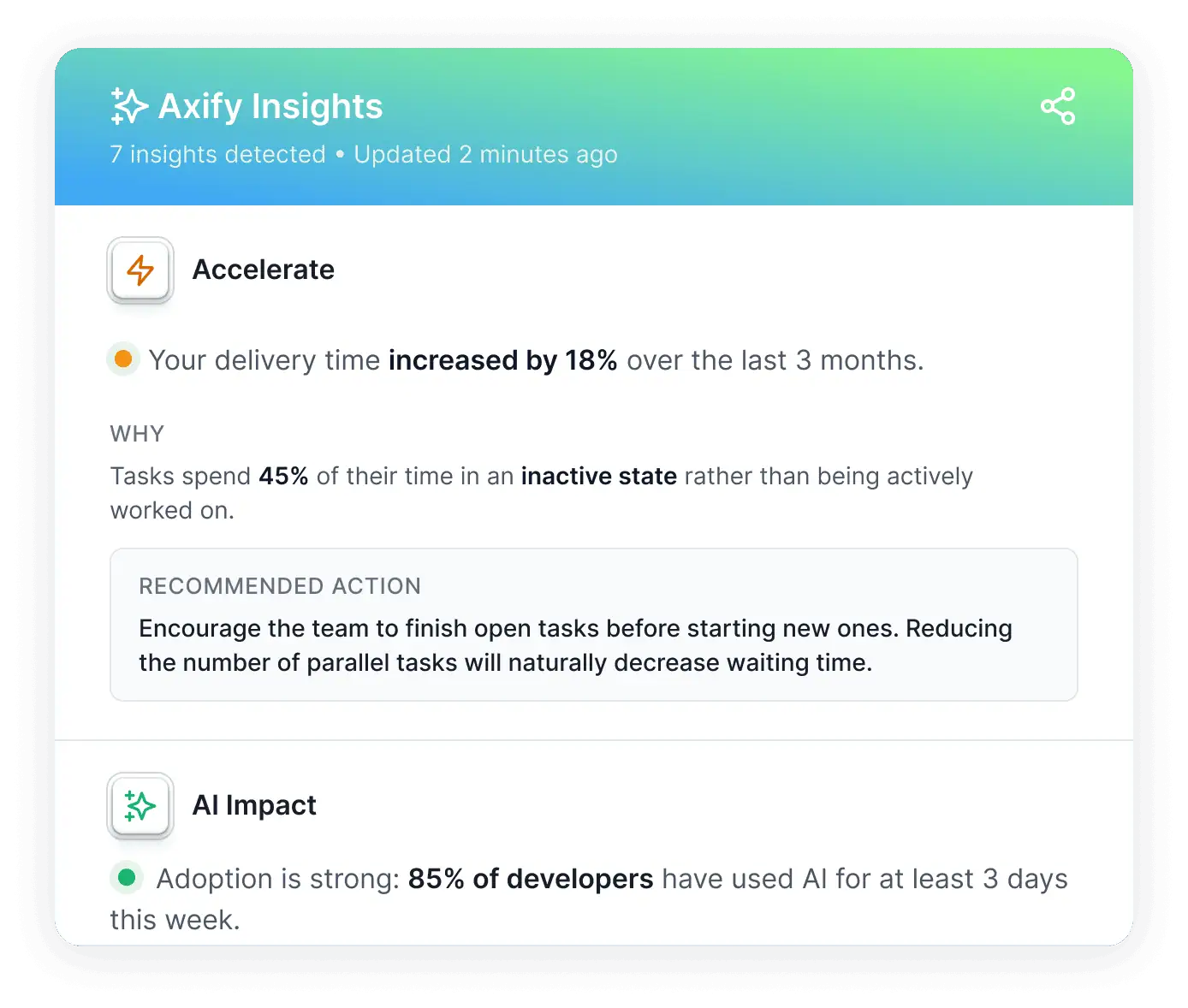
More importantly, this AI assistant supports conversational interaction. Teams can ask focused questions about specific stages, recent metric changes, or forecast implications.
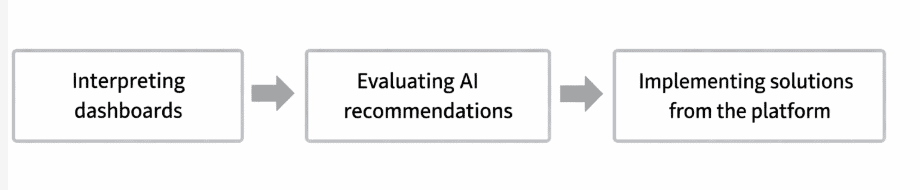
Then, the assistant provides context-aware responses and actionable recommendations grounded in your data. As a result, decision-making shifts from interpreting dashboards to evaluating proposed workflow adjustments and implementing solutions right from the platform.
In practice, a measurement framework only becomes useful when it connects metrics to operational decisions. At Axify, productivity frameworks are built through a structured process that combines delivery data, workflow analysis, and targeted interventions.
The first step is understanding how the delivery system currently behaves. Axify’s Developer Productivity Assessment gives you the kind of structured evaluation you need to establish baseline maturity level and structural gaps. You can also distinguish between productivity constraints caused by workflow design, tooling limitations, or coordination issues.
Once the baseline is established, teams analyze how work moves through the delivery pipeline using delivery metrics such as DORA and flow metrics.
Value stream mapping helps expose where work accumulates, while trend analysis reveals whether delays originate in planning, validation, review, or deployment stages. The goal is to identify structural constraints in the system.
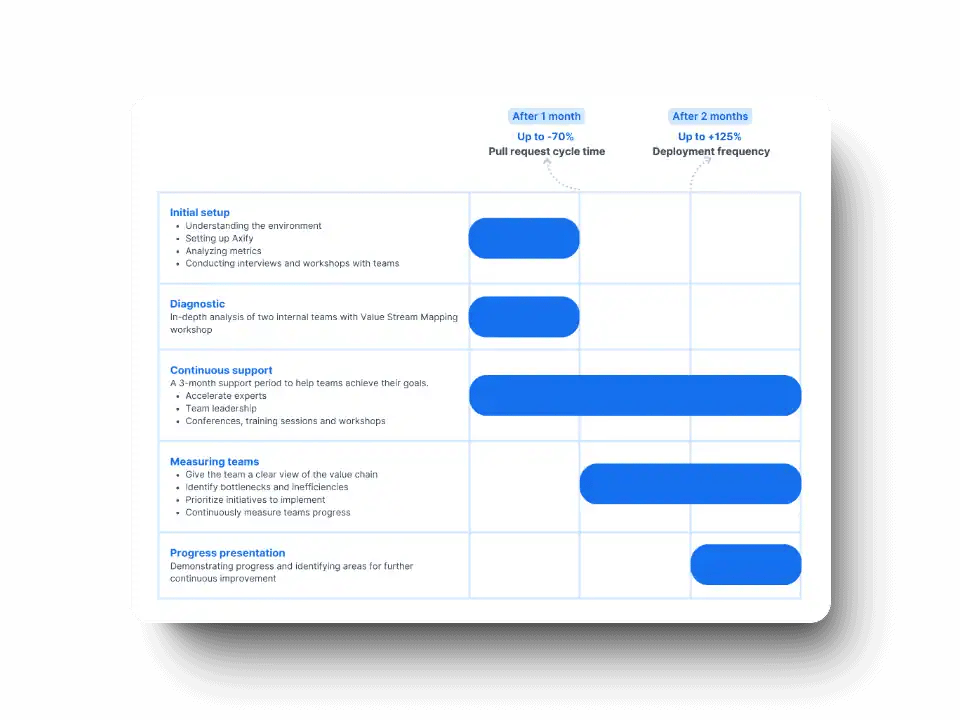
This approach helped two engineering teams at the Development Bank of Canada to identify inefficiencies in pre-development activities and quality control processes.
Within three months, delivery time improved by up to 51% and the teams gained an additional 24% development capacity, leading to $700k recurring productivity gains/year.
Here was our game plan:
When teams introduce new practices or tools, the next step is verifying whether they actually improve delivery outcomes.
Use Axify’s AI Impact to measure changes in delivery performance before and after AI adoption. That way, you can determine whether new tools accelerate delivery or simply shift delays elsewhere in the workflow.
Finally, productivity measurement becomes part of an ongoing improvement cycle. Use Axify Intelligence to surface insights tied to workflow decisions, identify bottlenecks, see likely causes, and get recommendations of targeted actions.
A measurement framework should clarify what decisions leaders make and what data informs those decisions. Without that link, metrics remain descriptive.
These are the core design elements your framework must address.
Measurement should answer operational questions that change what you do next. If your model cannot influence planning or intervention, it is incomplete.
These are the questions your framework must consistently address:
Start with time loss. Nearly half of developers lose up to 10 hours per week searching for information due to poor documentation and fragmented knowledge systems.
That friction slows the developer workflow, which affects development speed and increases idle time across teams. If pickup time, review latency, or rework loops increase, you can examine ownership clarity, documentation standards, or workflow design before adding headcount.
Next, focus on trend variability. A single data point does not inform a decision. Trends and variance do. You need to see when review queue time expands, when throughput variance increases, or when change failure rate moves beyond baseline.
In Axify, every metric includes trendlines so you can see how your engineering productivity evolves over time.
The value stream mapping view exposes where work accumulates and where flow remains stable. That contrast helps leaders decide whether to rebalance review capacity, adjust WIP limits, or address validation bottlenecks.
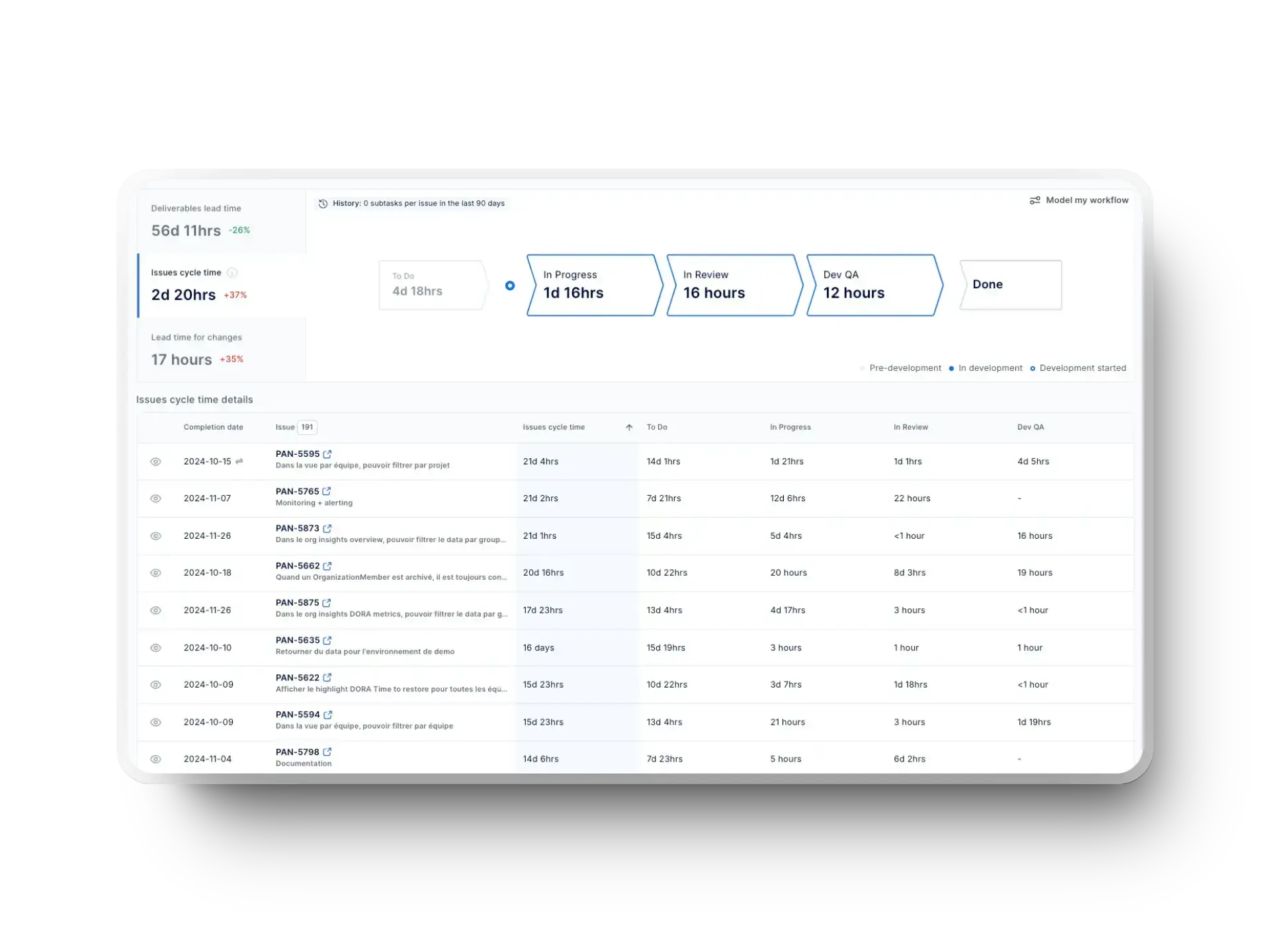
Meanwhile, the AI Impact feature helps you see if AI adoption influenced your delivery outcomes. This can help you identify whether new tooling improves your workflow or simply shifts delays to other stages.
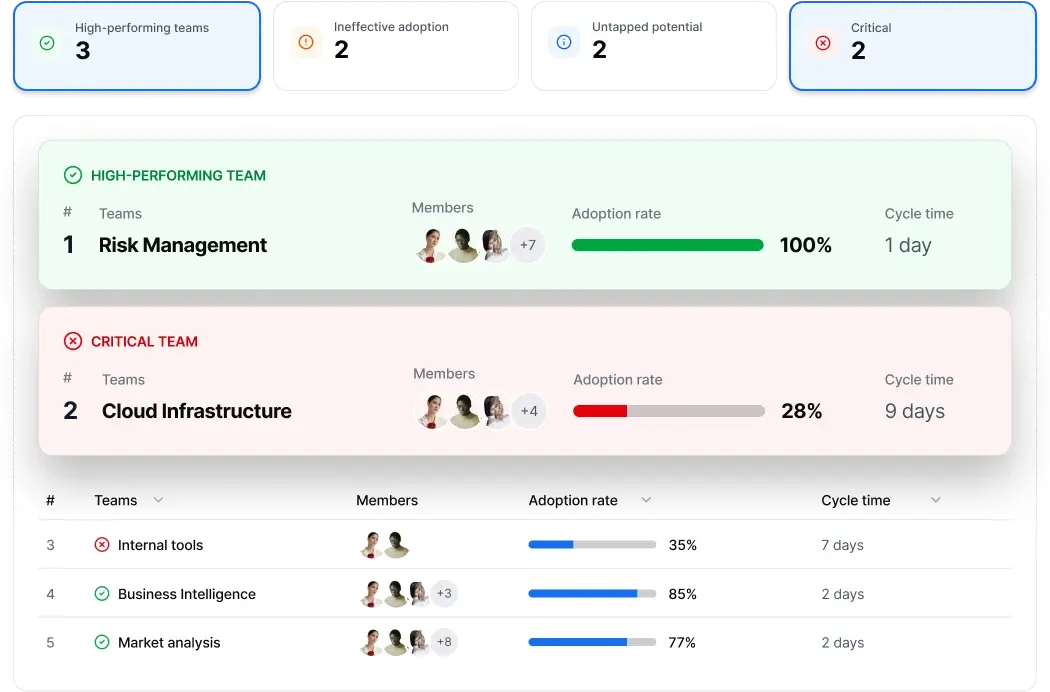
Review metrics at intervals aligned to the decisions they inform. Here’s what we recommend:
From our experience, good insight comes from trends, and rarely from single data points. A one-day spike in cycle time doesn’t typically justify intervention, but a three-sprint upward trend does.
That’s because operational systems fluctuate daily, but structural constraints indicate capacity imbalance, workflow breakdown, or growing risk exposure that will not self-correct without intervention.
Engineering leaders, managers, and technical leads should use the same measurement system, but apply it to different decisions. Alignment comes from shared definitions of cycle time, rework, WIP, and change failure rate.
Here’s how roles rely on measurement:
When rework increases or review queues expand, tech leads can justify structural fixes. When commit reliability drops or CFR rises, leadership can assess delivery risk before it affects revenue or margin.
Engineering productivity metrics should directly shape planning decisions. If planning ignores measurement, forecasts remain speculative.
When planning reflects actual system behavior, commitments become defensible and capital allocation becomes disciplined. When it doesn’t, risk accumulates until deadlines force reactive corrections.
Interpreting metrics means examining which stage of your delivery pipeline changed, what operational event triggered it, and which specific rule, ownership model, or capacity constraint needs adjustment.
If you skip that step, you might mistakenly add engineers when the real issue is review pickup delay, oversized pull requests, or work sitting idle between stages.
These are the factors that typically affect engineering productivity metrics:
Applying these filters helps you avoid reacting to temporary fluctuations and instead focus on whether a real workflow constraint requires intervention.
Let's consider a cycle time spike.
A sudden increase in cycle time does not automatically mean developers are slowing down. It means work is spending more time somewhere in the system.
If review queues expanded, the constraint may be limited reviewer capacity. If aging work is increasing, WIP limits may be too high. If testing time grew, environment stability may be the issue.
The goal is not to push teams to “move faster,” but to identify the constraint and reduce friction at that point.
Next, let's visualize rising throughput with declining quality.
Higher throughput with a rising change failure rate or increased defect volume signals imbalance.
Before reacting, ask:
Sometimes, teams increase output by reducing validation effort or compressing review time. That may temporarily improve delivery speed but increase rework and incident recovery time later.
The right response is to rebalance flow and reliability. That might mean strengthening CI coverage, adjusting WIP limits, or reinforcing review standards.
Finally, examine worsening predictability.
Predictability declines when planned work diverges from delivered work. That can happen even if throughput remains stable.
Start by examining variance patterns:
Worsening predictability may signal unstable prioritization, unclear scope, or frequent context switching.
Instead of increasing pressure to “commit harder,” leaders should reduce volatility. That may involve limiting parallel initiatives, improving backlog refinement, or protecting teams from mid-sprint priority shifts.
Remember: Predictability improves when the system becomes stable, not when expectations become stricter.
Measuring engineering productivity shouldn’t be done for its own sake. It should improve how you plan, prioritize, and intervene.
Having visibility is great, but using visibility to make the right decisions is better.
That’s what Axify helps you do.
With Axify, you connect delivery signals to bottlenecks, capacity constraints, and workflow policies, so trade-offs become explicit, and intervention becomes targeted. Instead of debating metrics, you evaluate causes, compare impact, and adjust with discipline.
With Axify Intelligence, you go a step further.
This AI decision-making partner gives you AI-driven insights based on your actual delivery history. You can explore root causes, ask questions through the AI assistant, and apply recommended actions directly. Visibility turns into guided intervention.
Book a demo with Axify to see how your delivery data can guide the next decision with clarity and confidence.

Engineering productivity is your organization’s ability to convert engineering effort into reliable, timely, and valuable software outcomes. It reflects delivery speed, stability, predictability, and quality across the full development system.
In theory, productivity is calculated as output divided by input, such as value delivered relative to engineering time or cost. In practice, software teams rarely use a single formula. Instead, they assess productivity through system-level indicators like delivery flow, stability, and predictability together, then tie those signals to planning and workflow decisions.
The most commonly used metrics include deployment frequency, lead time for changes, change failure rate, and time to restore service. Axify also tracks flow efficiency, review delays, work-in-progress distribution, bottlenecks, and the impact of the AI tools you implement.
No, DORA metrics alone are not enough because they show performance outcomes but not underlying workflow constraints. You still need flow visibility, bottleneck analysis, and structured interpretation to guide intervention decisions.
The best tool is one that combines metric visibility, system-level analysis, and actionable insight. Hence, Axify provides delivery dashboards, structured assessments, and AI-driven recommendations grounded in your internal delivery data.
Engineering productivity should be reviewed at different intervals: daily for flow disruptions, weekly for team adjustments, and quarterly for leadership planning. Trends over time matter more than isolated data points.