AI
14 minutes reading time

Some software teams adopted AI tools faster than they built a way to measure impact.
If you implemented AI assistants but release plans still miss, handoffs still slow teams down, and coordination still eats time, that’s usually the first sign your AI metrics are tracking activity, not delivery behavior.
This article closes that gap. We’ll treat AI as a change to your delivery system and measure its effects on flow, cost, risk, and decisions across your delivery system. You will learn how to determine whether AI usage reduced cycle time, lowered rework, stabilized throughput, or simply increased output without improving delivery reliability.
Let's get started.
Pro tip: If you can’t explain where AI improved delivery in one sentence, you’re not measuring it correctly. Axify gives you visibility automatically, recommends what to fix next, helps you implement changes, and lets you consult with an AI assistant. Try Axify today and move from AI activity to controlled delivery improvement.
Most AI measurement fails because it stops at tool usage and tool performance.
Teams track prompts, seats, sessions, feature clicks, or model benchmark scores. Those signals can tell you adoption is happening, but they do not tell you whether:
Benchmark scores and feature metrics also don’t capture system effects. They won’t tell you whether cycle time decreased, whether review delays shortened, or whether defect escape rates changed. Usage dashboards show activity, but they don’t explain impact.
That’s why leaders end up with a familiar pattern: more AI activity, unclear delivery improvement, and harder prioritization.
This gap is widely recognized. Gartner reports that 49% of business leaders say proving AI business value is their biggest adoption challenge.
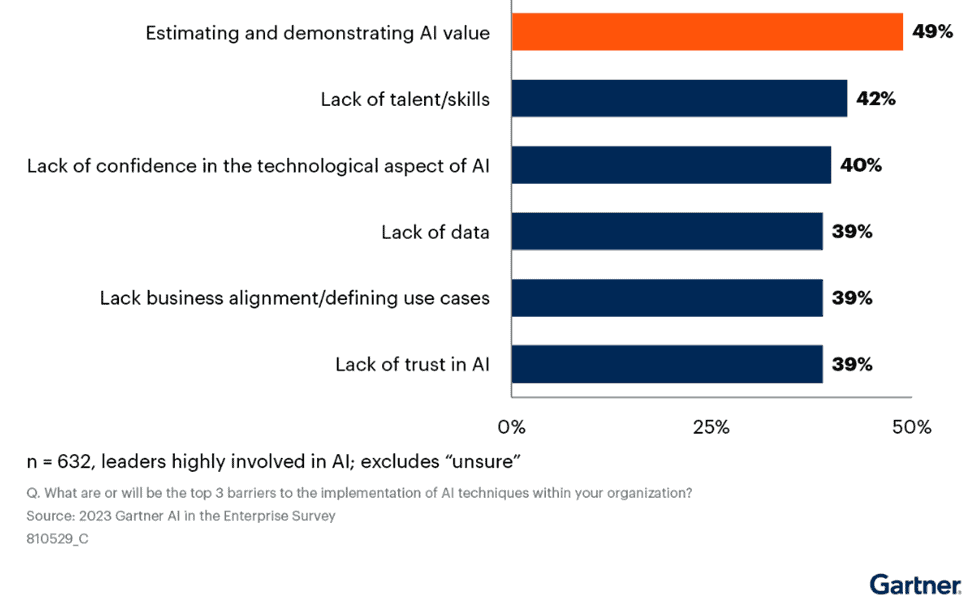
Source: Gartner
That number reflects the same problem you face: measurement and evaluations focus on narrow, tool-related metrics and not on the macro level: delivery flow, cost structure, or risk.
When that visibility is missing, decision-making becomes harder. You can’t decide where to invest, what to standardize, or what to roll back based on adoption signals alone.
That brings us to the next point.
Real business impact from AI is reflected in ROI, faster time to market, lower cost of delivery, and reduced risk exposure.
But those financial outcomes appear only when delivery mechanics change.
AI does not create ROI directly. It changes how work moves through planning, development, review, validation, and release. Those changes alter lead time, rework, coordination load, and production stability. Financial impact is downstream.
That’s why we advise you to look beyond narrow tool-related AI metrics; after all:
None of those scenarios shows a durable ROI being produced.
To connect AI to business results, you need a clear chain:
Delivery mechanics → Operational outcomes → Financial impact
For example:
Unfortunately, industry surveys often stop at outcome labels, too.
Deloitte’s 2026 AI report notes that 66% of organizations report productivity gains, 53% report better decision-making, and 40% cite cost reductions.
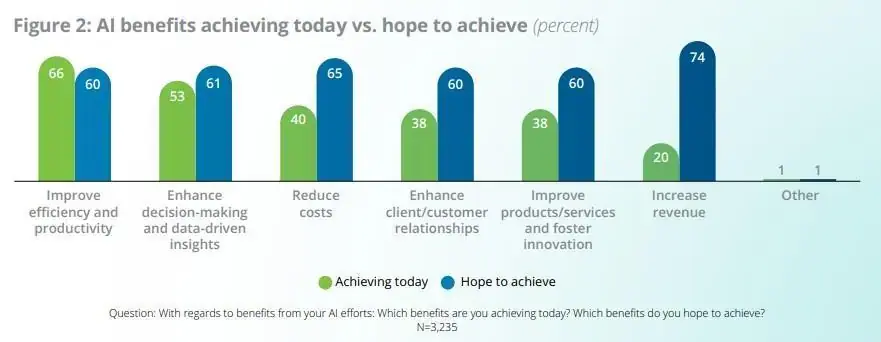
Source: Deloitte’s 2026 AI report
These are results categories, not causal explanations. Without delivery signals underneath them, attribution remains weak.
AI should be evaluated as a structural change inside the delivery system. It modifies how code is produced, reviewed, and released. That is where measurable impact begins.
Pro tip: AI also acts as an amplifier. In a stable workflow, it reduces wait time and rework. In a constrained system, it increases PR volume, review queues, and downstream defects. Business impact depends on which effect dominates.
Most AI reporting looks rigorous, yet it rarely explains why your delivery system improved or deteriorated. The problem is not data scarcity but misaligned AI metrics.
These are the three patterns that distort how you interpret impact.
Accuracy, BLEU, F1 scores, or latency improvements in large language models describe technical capability, but they don't explain operational effect. A model can generate higher-quality code suggestions, yet lead time for changes may remain unchanged if review queues or approval policies stay the same.
Also, lower response latency does not reduce rework if generated changes still require significant correction. Technical gains only matter when they change delivery flow, cost, or risk.
Seats activated, sessions opened, prompts submitted, or tokens consumed tell you who is using the tool and how. They do not tell you whether the work reached production faster or with fewer defects.
High usage may reflect experimentation but not improvement. We think usage becomes meaningful only when you connect it to shifts in system-level engineering metrics, like cycle time, deployment frequency, or defect escape rate.
Your output volume can increase while your system health can decline. The DORA 2025 report notes how AI can amplify existing practices, for better or worse. If workflow discipline is weak, AI-assisted engineering can intensify that weakness. For example, you can have:
In those cases, metrics that look positive in isolation become misleading. These are typically treated as “vanity” indicators when measured without context, including:
Without linking them to system metrics, they obscure tradeoffs instead of clarifying impact.
This leads us to the next point.
To assess the impact AI tools have on software development, teams need a structured measurement lens. The framework below evaluates how AI adoption influences software delivery across four dimensions that shape engineering performance and leadership decisions: delivery speed, cost structure, system stability, and decision quality.
Delivery impact metrics show how AI changes flow, speed, stability, and throughput across your system. Instead of simply evaluating tool features, you compare performance before and after AI adoption and observe whether delivery behavior shifts in measurable ways.
Pro tip: Before tracking system-wide impact, set clear expectations. The first changes appear at the lowest level of the delivery loop, and they are not always improvements.
| “When teams adopt AI, the first measurable impact shows up at the pull request level, not at the issue or delivery level. It can even have a negative effect at first, as more code creates pressure on review, testing, and deployment. As teams adapt, the impact becomes visible at higher levels like issues and overall delivery.” (Pierre Gilbert, Software Delivery Expert, Axify) |
In practice, PR throughput, PR size, and review time are usually the first metrics to change. Metrics like cycle time or lead time take longer to improve because more code initially creates pressure on downstream steps in the delivery process.
This is where Axify can also help.
Through our AI Impact capability, you can correlate AI adoption levels with changes in core process metrics and compare cohorts with and without AI support.
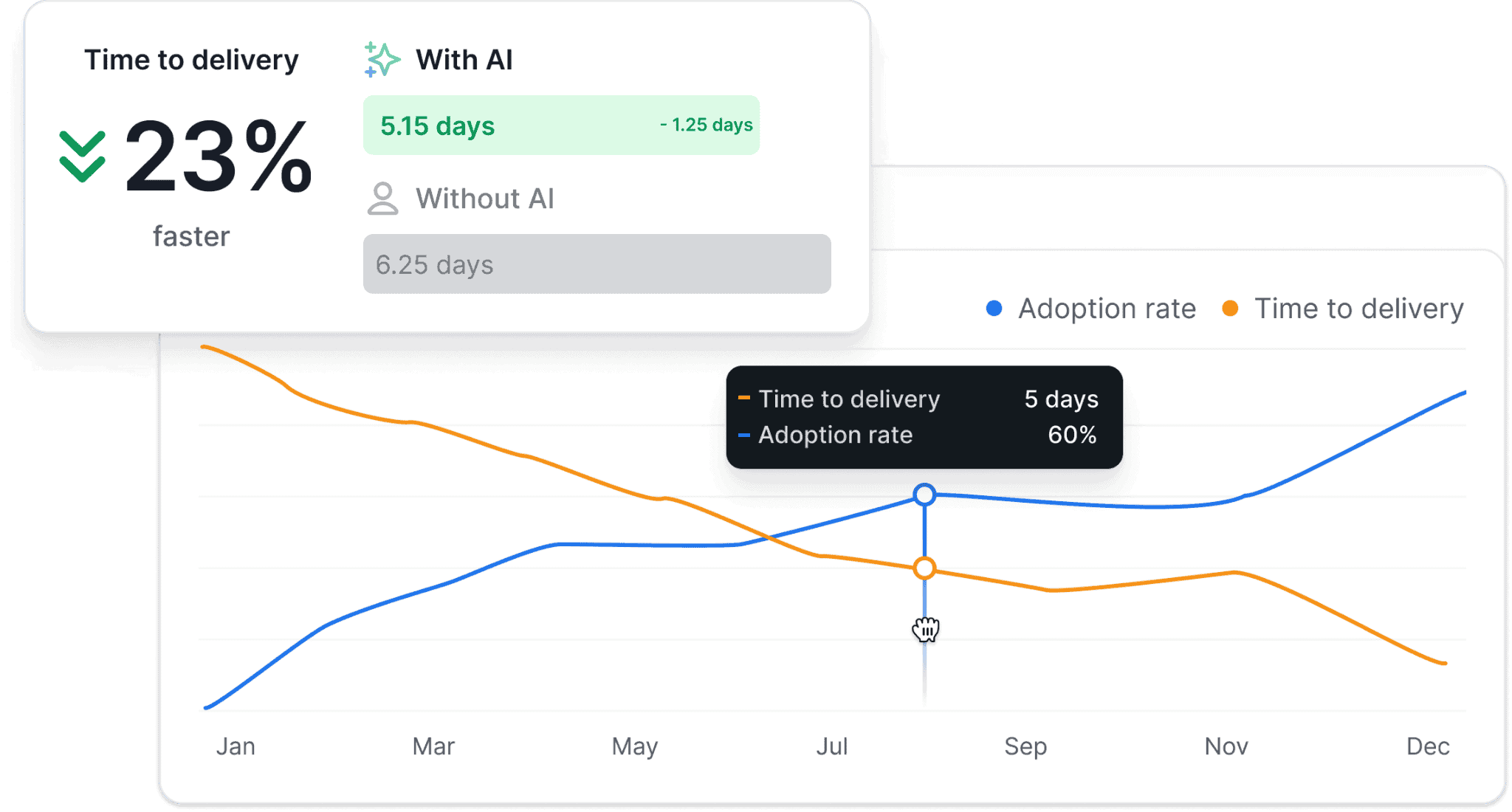
That said, you should focus on:
These metrics connect directly to business value because they reflect how reliably work moves through your pipeline. When AI increases output but destabilizes deployment metrics, you face planning risk.
But when AI adoption correlates with lower cycle time and steady throughput, you gain predictable delivery. That is a measurable impact.
Cost impact measures whether AI reduces the cost per validated change, not whether it increases output.
Speed alone does not lower cost. Cost improves only if AI changes effort distribution without increasing downstream correction, coordination, or risk.
Assess cost using these signals:
Side note: In fact, recent data shows developers now spend about 9% of their total time reviewing and correcting AI-generated code instead of building new functionality. If that time displaces net-new delivery, the cost structure does not improve.
If AI output requires heavier review, correction, or parallel workflows, the total amount of work increases. To see cost improvements, you need a net reduction in effort across the entire lifecycle, not isolated gains in code generation.
As Pierre Gilbert explains, the real impact of AI depends on how efficiently work moves through the delivery pipeline.
“One of the most overlooked factors in AI adoption is flow efficiency. I’ve seen many organizations accelerate coding with AI, only to create new bottlenecks in reviews, testing, or deployment. When that happens, the total effort doesn’t actually decrease because the work just moves downstream. The teams that truly benefit from AI are the ones that optimize how work flows across the entire delivery system.”
Pierre Gilbert
Software Delivery Expert, Axify
And if you’re tracking flow efficiency, you can use our Value Stream Mapping feature, which gives you a clean view of your operations and value creation across SDLC phases.
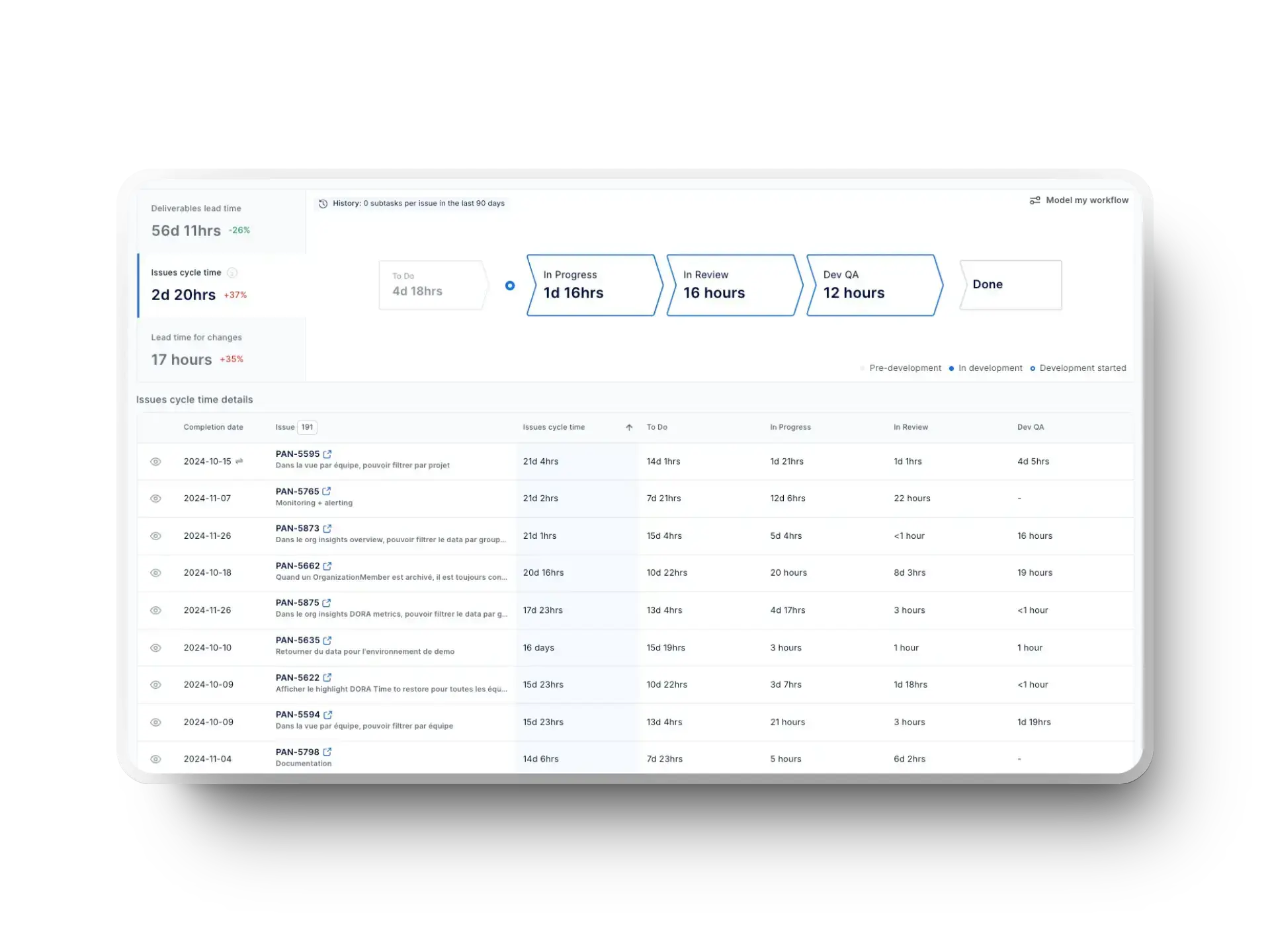
Risk impact measures how AI impacts your operational risk profile. Specifically, whether it increases or reduces failure probability, defect escape, recovery time, and delivery predictability.
Pro tip: With Axify’s AI Impact capabilities, you can correlate AI adoption levels with change failure rate, rollback frequency, throughput variance, and MTTR. This lets you determine whether increased AI usage coincides with stable delivery or rising operational risk.
You can identify teams where AI reduces rework and stabilizes throughput, standardize effective patterns, and intervene where failure rates or review load increase.
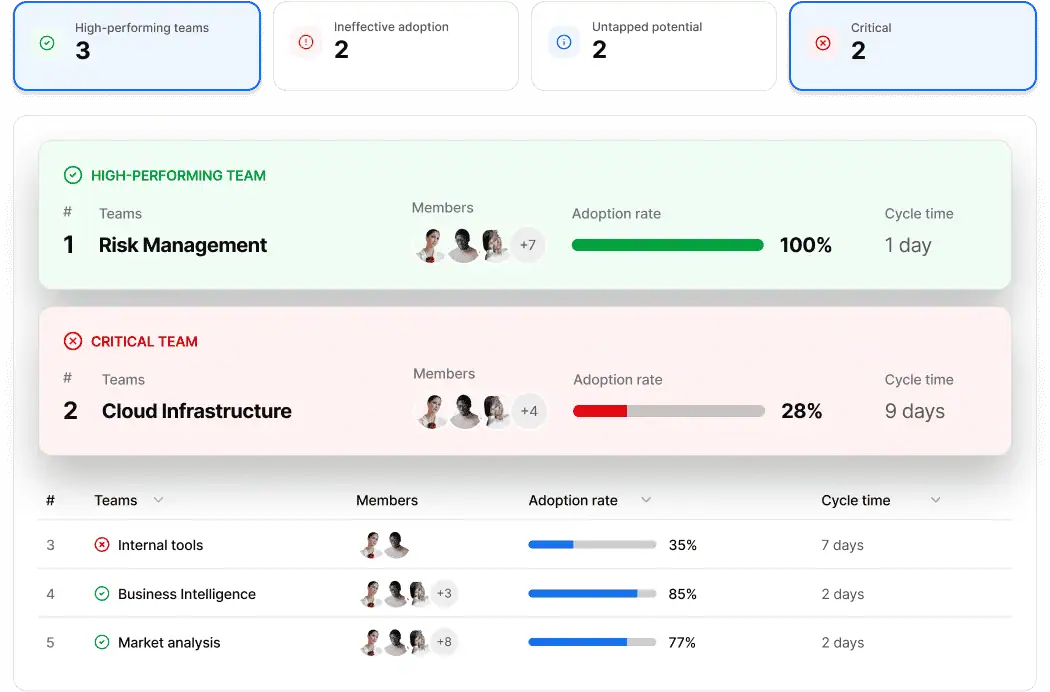
Remember: Higher throughput is not an improvement if failure rates, rollback frequency, or recovery time increase. Risk exposure must be evaluated alongside flow and cost to determine whether AI strengthens or destabilizes the system.
In Axify’s framework, you assess risk through measurable deltas before and after AI adoption:
Decision impact refers to how AI affects your decision-making process. Specifically, whether it facilitates planning and execution decisions or not. It’s important to remember that a faster output does not automatically lead to better decisions.
What matters is whether you can:
In Axify’s AI measurement framework, decision impact is measured using the following indicators (before and after AI implementation):
These indicators show whether delivery is predictable and whether planning decisions are reliable.
One question remains: how do you respond to AI’s impact on your team performance?
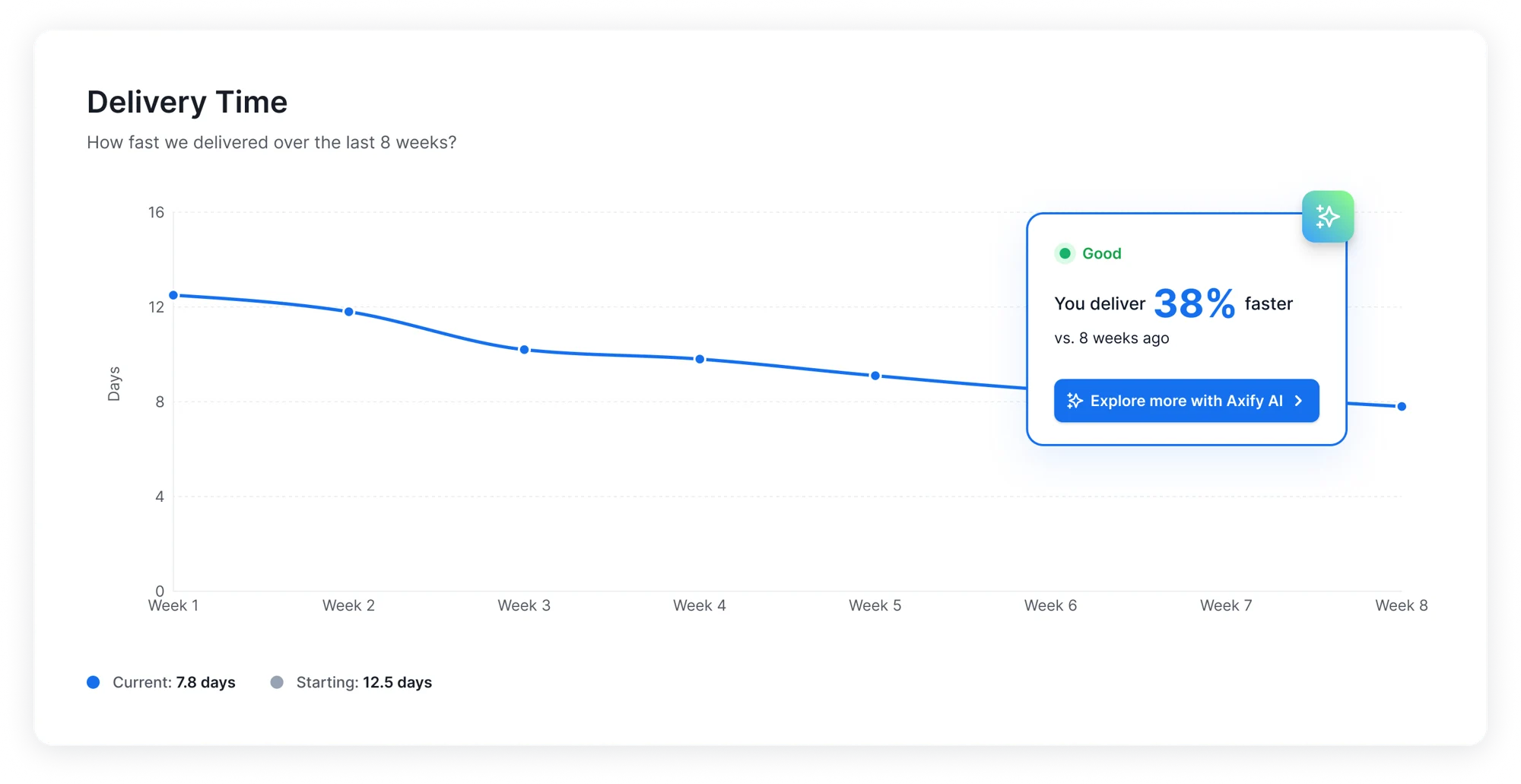
Axify Intelligence is the tool you need to turn delivery data into concrete actions.
It identifies bottlenecks, shows you actionable insights based on historical data, and recommends specific adjustments to the workflow.
Engineering leaders can implement these recommendations directly from the platform.
Because Axify uses your actual delivery data, the recommendations reflect how your team works. This allows faster response when AI affects delivery speed, cost, or risk.
Measuring AI’s real impact requires a proper structure. That means you need disciplined comparison and system-level observation.
Here are the steps we encourage you to follow.
Document delivery performance before adoption:
Without a defined baseline window, improvement claims are not verifiable.
Roll out AI in defined teams, repositories, or workflow stages rather than across the organization at once. This limits confounding variables and allows you to isolate whether changes in your engineering metrics correlate with AI usage.
Adoption does not equal impact. More interestingly, executive adoption is faster than employee adoption.
In fact, Business Insider reports executive AI usage at 87%, compared to 27% among employees. That gap creates a risk: leadership perception of progress can be completely different from actual adoption. In turn, even the current AI usage rate doesn’t necessarily trigger measurable changes in delivery.
As such, we encourage you to:
Use both pre/post comparisons and parallel team comparisons. Evaluate:
Control for team size and scope where possible. If differences persist after normalization, AI is a plausible contributing factor.
Monitor rework, review load, and coordination time because those signals show whether faster output is creating downstream friction. If defect correction increases or review queues grow, net capacity does not improve even if raw throughput rises. That is why impact must be evaluated beyond first-order output.
Measure how the system behaves over time, not just whether output increases.
Track throughput volatility, commit reliability, forecast drift, and unplanned work ratio before and after AI adoption. If output rises temporarily but forecast accuracy declines or reactive work increases, instability is increasing.
Sustainable improvement appears as consistent throughput, stable forecasts, and fewer corrective interventions. Short-term spikes followed by correction cycles indicate that AI is amplifying variability rather than strengthening the system.
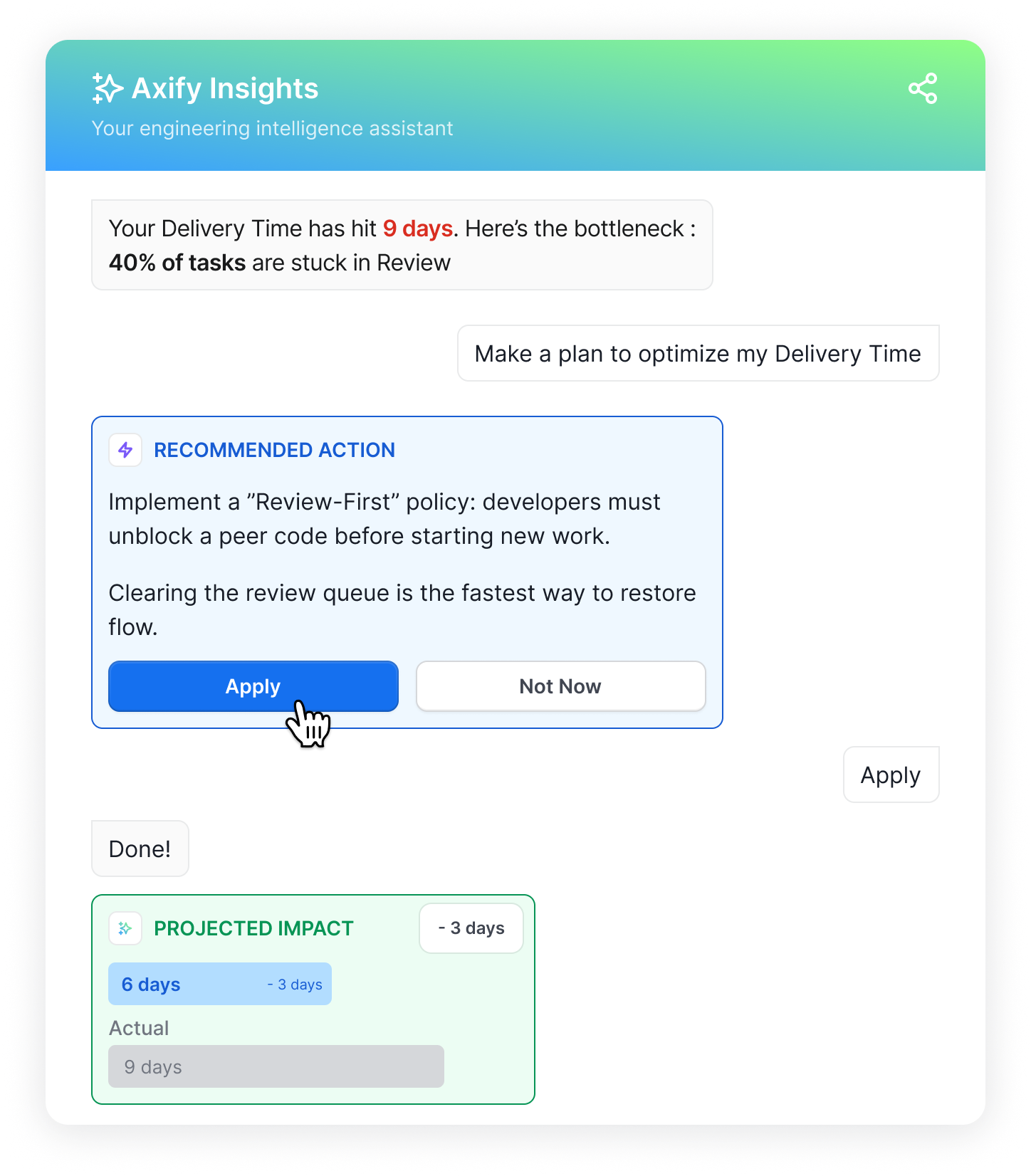
Axify Intelligence operationalizes this measurement process. It continuously analyzes delivery data to detect bottlenecks, connect related signals, and explain root causes using your historical trends. It then recommends corrective actions tied to workflow mechanics.
Leaders can:
Because it operates on your system data, not generic prompts, decisions are grounded in how your organization actually delivers.
AI measurement fails for two reasons: teams track the wrong signals and then draw the wrong conclusions from the signals they do have. When adoption scales without a disciplined evaluation plan, leaders can’t separate real system change from noise.
Common mistakes:
Good AI measurement lets you make defensible operational and financial decisions based on observed delivery behavior. It shifts the conversation from “Are people using AI?” to “What changed in flow, cost, and risk, and should we scale it?”
These are the outcomes that follow:
AI measurement becomes credible when it explains how adoption changes delivery flow, cost structure, risk exposure, and planning quality.
Throughout this guide, you saw that usage metrics and model benchmarks do not answer executive questions about predictability, margin, or capital allocation. What matters is whether cycle time shifts, rework declines, failure rates stabilize, and forecasts become more accurate.
Axify gives you more than visibility.
It connects AI adoption levels, acceptance rates, and interaction patterns to concrete delivery signals such as throughput stability, review latency, defect density, and forecast variance. As such, you understand what changed, where it changed, and what it means for delivery performance.
Axify Intelligence goes further by turning those signals into decisions.
It detects bottlenecks, explains root causes using your historical data, recommends corrective actions tied to workflow mechanics, and lets you act directly.
If you want disciplined AI evaluation that leads to faster, defensible decisions, book a demo with Axify and see how your data drives execution.

Measure AI by comparing delivery, cost, risk, and decision metrics before and after adoption. Track cycle time, change failure rate, rework, and forecast accuracy rather than prompts or licenses. Tools like Axify help correlate adoption levels with workflow outcomes so you can see whether performance actually improved.
The best AI measurement framework evaluates system impact across delivery speed, cost drivers, risk exposure, and decision quality. A single metric cannot explain performance change.
But a structured model, such as Axify’s four-dimension approach, correlates AI usage and acceptance rates with observable shifts in throughput, defect correction, and predictability.
You should expect a measurable impact within one to two planning cycles if adoption meaningfully changes workflow behavior. However, early improvements may affect speed before stability or cost savings appear. Sustainable impact shows up as consistent performance.
Yes, AI can degrade performance if it increases rework, review load, or coordination overhead. Faster code generation without process alignment can raise change failure rates. Impact depends on how well AI integrates within your existing delivery practices.
AI metrics should be reviewed at the same cadence as delivery performance, typically weekly for operational signals and monthly for trend analysis. Frequent review helps you detect volatility before it compounds.
Use tools that connect adoption data with delivery metrics. Platforms like Axify combine workflow analytics with contextual insights, which allows you to interpret cause and effect across your system. Besides, Axify’s AI Intelligence showcases bottlenecks and recommends solutions based on these analytics, so leaders can implement data-driven decisions right from the platform.